2025 Travelers' Choice

About Backcountry Journeys
Why Choose Backcountry Journeys
If you're considering a photography trip, hear why Backcountry Journeys delivers the best experience in the industry.Frequently Asked Questions
If you're new to photography trips, or new to BCJ, you can find our common travel questions here.Fitness Levels
Our trips vary on physical intensity, and by reviewing our fitness levels, you can find out which trips may be more challenging, or aligned more closely with your comfort level.Meet The Crew
We've built an amazing team of experienced guides, and dedicated office staff that elevate your travel experience. Get to know their backgrounds, and hear their stories.Loyalty Program
We reward our frequent photo adventurers with exclusive discounts on amazing photography trips.Contact Us
If you need to get in touch with our office staff, or have additional business inquiries, you can find our information here.Refer a Friend
Know someone perfect for one of our tours? Recommend them through this quick form.Stay Up To Date On All Things
Backcountry Journeys
Backcountry Journeys
Our Photography Community
Our Webinars
Our regularly hosted webinars provide photography instruction from our own guides on a wide range of topics.Our Education Portal
Explore our library of articles that cover everything from common questions, to in-depth guides on how to achieve that perfect shot.Community Testimonials
We're proud to foster an amazing group of photo travelers, and here you can find their stories from their past adventures.Resources For Photographers
About Our Company
Resources For Photographers
About Our Company
Beyond the Postcard: Finding Your Own Perspective in the Cypress Swamps of Caddo Lake
Published October 16, 2026
Some landscapes practically beg for a wide-angle lens. Caddo Lake, where ancient cypress trees rise from dark water and Spanish moss hangs in delicate curtains, is one of them. But the challenge for photographers isn't simply capturing the beauty of this extraordinary place. It's finding a way to make an image that feels like your interpretation of it.
Sprawling across the Texas-Louisiana border, Caddo Lake offers a world of tangled branches, intricate reflections, atmospheric light, and wildlife tucked between narrow waterways. In autumn, cypress foliage adds shades of copper, rust, and orange to an already remarkable landscape. When mist settles over the water, familiar shapes become silhouettes, and the entire scene can feel more like a painting than a photograph.
For photographers, this environment presents a compelling creative challenge: How do you make sense of a landscape with so much happening in the frame?
The answer might be to change your lens, rethink your composition, or resist the urge to photograph the entire scene at all.
Put the Wide-Angle Lens Down
A wide-angle lens is an obvious choice for photographing a place as expansive and atmospheric as Caddo Lake. It can capture towering trees, sprawling canopies, water, and sky. But wide-angle photography can also introduce a problem: everything in the scene becomes a potential subject.
Branches overlap. Trees compete for attention. The foreground expands, and the distant details that initially caught your eye become tiny elements in a much larger composition.
Sometimes, try switching to a telephoto lens instead.
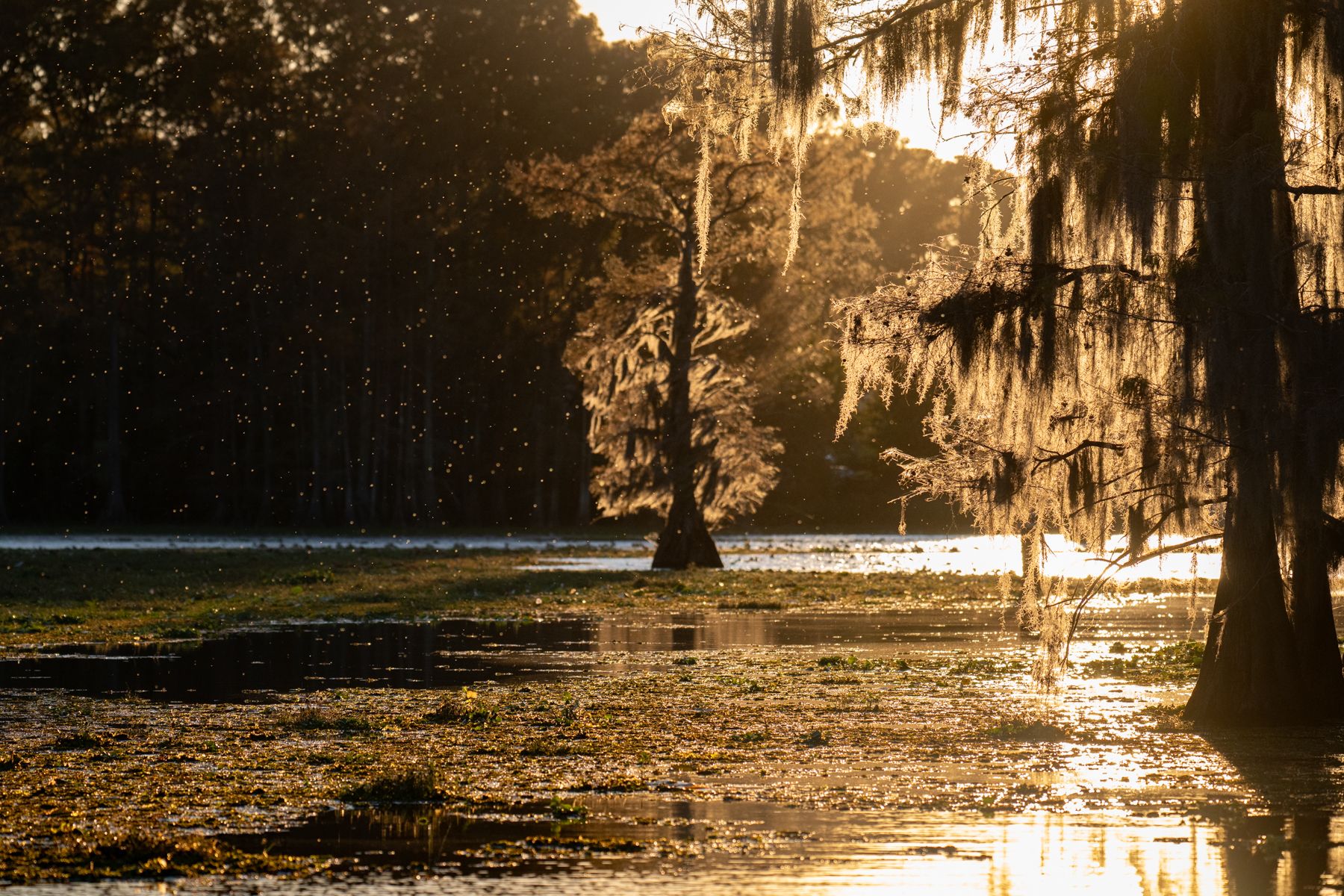
A focal length in the 70–200mm range can help isolate individual cypress trunks, compress layers of trees, and bring distant patches of color closer together. Rather than documenting the entire swamp, you can create a more intimate image built around repeating shapes, subtle contrasts, and carefully selected details.
Look for a single tree framed by two darker trunks. Watch for a strip of orange foliage appearing between layers of Spanish moss. Find a distant silhouette that seems to float in the haze.
The goal isn't to show everything you see. It's to decide what matters most.
Try spending 15 minutes photographing the same area without using your widest lens. Look for three compositions that would have been difficult to notice through a wide-angle viewfinder. You may discover that limiting your options actually expands your creative possibilities.

Treat Fog as a Composition Tool
Fog is one of those conditions landscape photographers often hope to find when they wake before sunrise. At Caddo Lake, it can do much more than create an atmospheric backdrop.
It can simplify a complicated scene.
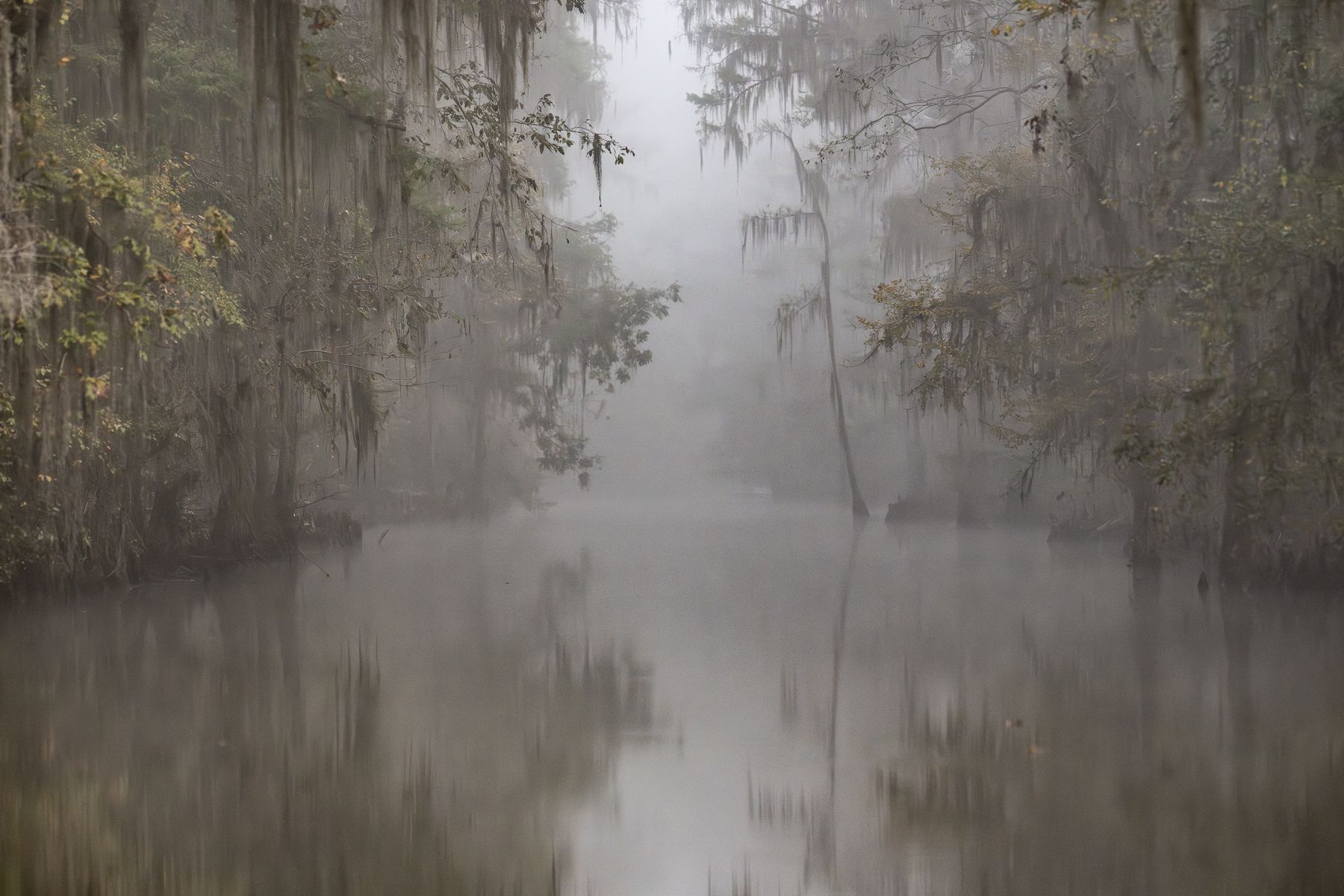
In a dense forest, every tree, branch, and patch of foliage competes for visual attention. Mist softens distant elements, reduces contrast, and separates layers that might otherwise blend together. A chaotic tangle of trees can suddenly become a sequence of silhouettes receding into the distance.
Instead of asking, "Where is the best view?" try asking, "What is the fog helping me see?"
Look for a dark foreground tree against a lighter layer of mist. Watch for gaps between trunks that create natural pathways into the image. If sunlight breaks through, pay attention to the way it illuminates the edges of branches and catches the hanging moss.
Your exposure may need some attention, too. Automatic metering can interpret a bright, fog-filled scene as something that should be darker than it appears to your eye. Check your histogram and exposure warnings, and use exposure compensation when necessary to preserve the brightness of the mist without losing important highlights.
And remember: fog isn't guaranteed. If the morning arrives clear, you haven't lost your opportunity. The absence of mist may reveal cleaner reflections, more defined textures, and stronger color separation.
The best photographs often come from responding to the conditions you have rather than waiting for the ones you imagined.
Reflections Are More Than a Mirror
Still water can make a beautiful landscape feel almost surreal. At Caddo Lake, reflections double the cypress trees, repeat their intricate shapes, and turn autumn foliage into ribbons of color across the water.
But perfectly symmetrical reflections aren't the only compositions worth pursuing.
Try treating the water as a subject in its own right. A slight breeze might distort the trees into painterly streaks. A reflection of orange foliage against nearly black water can become an abstract study in color. The mirrored curve of a branch might create a shape more compelling than the branch itself.
There are several approaches worth experimenting with.
For a classic reflection, use a relatively wide composition to emphasize symmetry between the trees and their reflections. Keep your camera level and pay attention to where the waterline falls in the frame.
For an abstract reflection, zoom in and remove the recognizable landscape. Concentrate on color, shape, and texture until the image becomes an abstract photograph rather than a record of a place.
For a broken reflection, photograph the subtle ripples created by wind or moving wildlife. Instead of treating the disturbance as a flaw, use it to introduce movement and contrast.
Your shutter speed can change the character of the water, too. A faster exposure can preserve fine ripples, while a longer exposure may soften their texture. If you're photographing from a boat, however, remember that camera movement can undermine sharpness during long exposures.
This is a useful reminder that technical decisions should support the image you're trying to make. There is no universally correct shutter speed for a reflection.

Find Your Perspective at Caddo Lake With Backcountry Journeys
The Southern Cypress Swamps of Caddo Lake offer a rare opportunity to slow down and reconsider how you approach landscape photography. Here, the challenge isn't finding something beautiful to photograph. It's learning to see beyond the obvious.
One morning might reward you with mist drifting between towering cypress trees. Another might offer nothing more than soft overcast light, subtle reflections, and a heron moving quietly through the water. Both can produce exceptional photographs when you understand how to work with the conditions.
That's what makes photographing this environment so rewarding: every change in light, weather, and perspective presents a new creative problem to solve.
On the Southern Cypress Swamps: Caddo Lake Photo Workshop, Backcountry Journeys explores this remarkable landscape by private boat, with sunrise and sunset photography sessions, opportunities to photograph wildlife, and time for image review and critique. The small-group format creates opportunities to learn alongside fellow photographers while working through the challenges of making stronger images in the field.
Bring your wide-angle lens, pack your telephoto, and leave a little room on your memory card for the unexpected.
You might arrive looking for the perfect reflection. You might leave with something even better: a new way of seeing.


 Southern Cypress Swamps: Caddo Lake
 Lodge-Based Photo Workshop
From $5,995.00
Up To 6 Guests
Fitness Level 1 - What's This?
Wanna Get Away?
Starts
Current Price:$0.00
Start: Shreveport, LA
Led By
Start: Shreveport, LA
Led By

Backcountry Journeys
Connecting Passionate People To
Exceptional Experiences.
Exceptional Experiences.
Business Hours:
Mon-Fri, 8AM-4PM MT
928-478-1521
adventure@backcountryjourneys.com
Mon-Fri, 8AM-4PM MT
928-478-1521
adventure@backcountryjourneys.com
arrow_drop_down_circle
Divider Text
All Images & Content Are Property Of Backcountry Journeys Photography Tours, Workshops & Safaris LLC - Copyright 2026


About Us
Receive a Digital Trip Catalog
Find an upcoming photography tour with our interactive catalog.