2025 Travelers' Choice

About Backcountry Journeys
Why Choose Backcountry Journeys
If you're considering a photography trip, hear why Backcountry Journeys delivers the best experience in the industry.Frequently Asked Questions
If you're new to photography trips, or new to BCJ, you can find our common travel questions here.Fitness Levels
Our trips vary on physical intensity, and by reviewing our fitness levels, you can find out which trips may be more challenging, or aligned more closely with your comfort level.Meet The Crew
We've built an amazing team of experienced guides, and dedicated office staff that elevate your travel experience. Get to know their backgrounds, and hear their stories.Loyalty Program
We reward our frequent photo adventurers with exclusive discounts on amazing photography trips.Contact Us
If you need to get in touch with our office staff, or have additional business inquiries, you can find our information here.Refer a Friend
Know someone perfect for one of our tours? Recommend them through this quick form.Stay Up To Date On All Things
Backcountry Journeys
Backcountry Journeys
Our Photography Community
Our Webinars
Our regularly hosted webinars provide photography instruction from our own guides on a wide range of topics.Our Education Portal
Explore our library of articles that cover everything from common questions, to in-depth guides on how to achieve that perfect shot.Community Testimonials
We're proud to foster an amazing group of photo travelers, and here you can find their stories from their past adventures.Resources For Photographers
About Our Company
Resources For Photographers
About Our Company
Croatia Through the Lens: A Photographer’s Guide to Its Most Remarkable Landscapes

Published August 7, 2026
Croatia is often pictured in shades of blue: the Adriatic Sea, sunlit coastlines, island villages, and waterfront cities. But for photographers, that familiar image only tells part of the story.
Travel inland and the scenery begins to shift. Medieval hill towns rise above rolling landscapes. Narrow stone streets lead into colorful coastal villages. Centuries-old churches and monasteries reveal intricate architectural details. Rivers tumble through forests, waterfalls cut through limestone, and turquoise lakes seem to change color with every turn.
In just nine days, a photographer can move through an extraordinary range of environments, each one asking for a different way of seeing and photographing the world.
That is what makes Croatia such a compelling photographic destination. It isn't one landscape. It is a collection of visual worlds layered together, from the hilltops of Istria to the waterfalls of Krka and the forests and turquoise waters of Plitvice Lakes.
Istria: Medieval Towns Above the Landscape
The journey begins in Istria, where photography takes on an almost storybook quality.
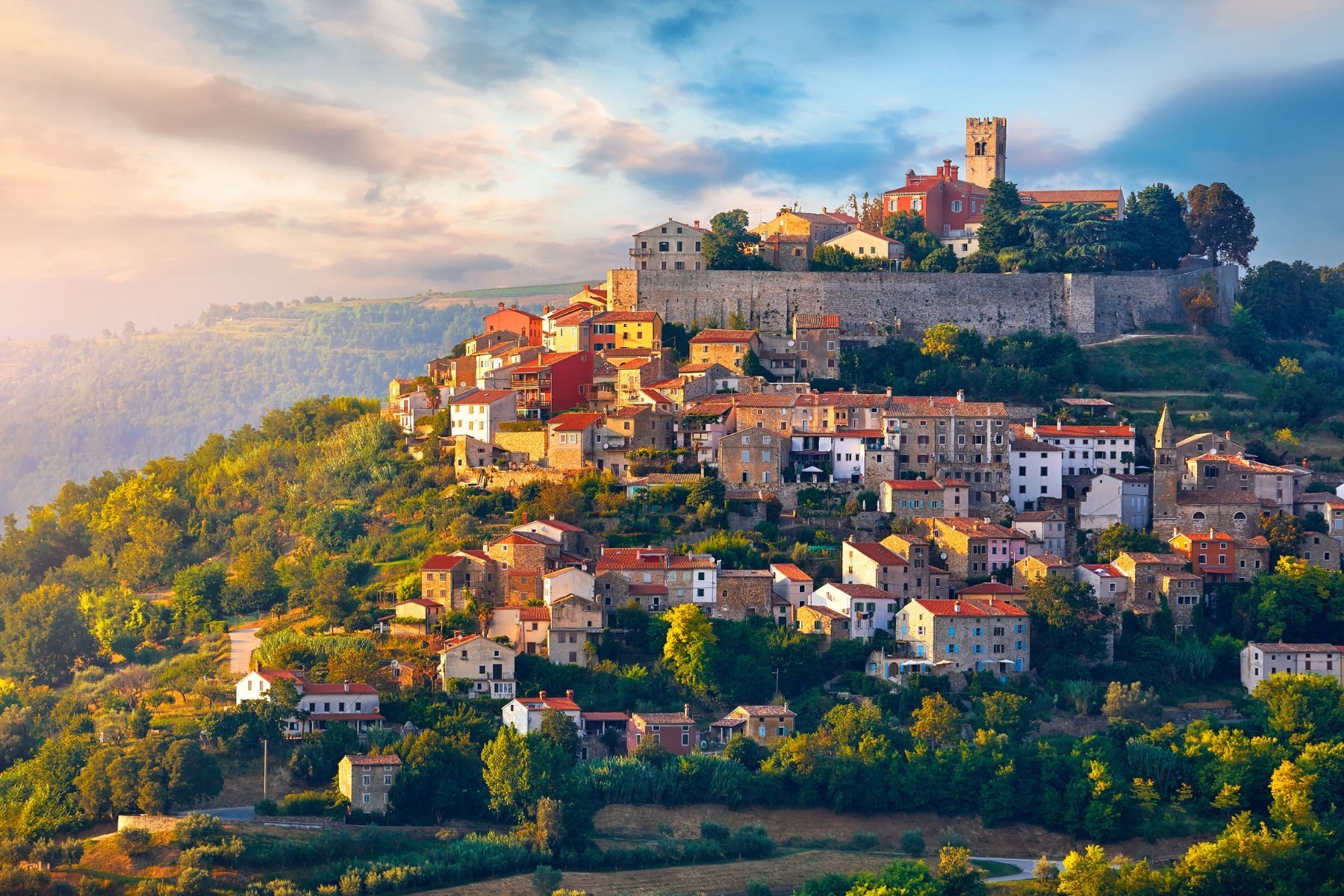
The peninsula is dotted with medieval hilltop towns, rolling countryside, stone buildings, narrow streets, and expansive views. Among them, Motovun offers one of the most distinctive perspectives. Perched above the surrounding landscape, the historic town creates opportunities to photograph both intimate architectural details and broad panoramas.
For photographers, places like Motovun encourage a different approach than a traditional landscape destination. The subject isn't simply the scenery. It is the relationship between the town and the landscape surrounding it.
Stone walls frame distant hills. Ancient rooftops create repeating patterns. Narrow alleyways reveal small architectural details. From elevated viewpoints, the landscape stretches outward in layers.
That variety gives photographers room to experiment with composition. A wide-angle image can establish a sense of place, while a longer focal length can isolate rooftops, towers, and distant hills.
Then there are the details that make Istria feel distinctly its own: weathered stone, colorful facades, old doorways, winding streets, and centuries of architectural history.
Instead of photographing one iconic landmark and moving on, Istria rewards photographers who slow down and look at how all those elements fit together.
Rovinj & Pula: Where Architecture Meets the Adriatic
From the hill towns of Istria, the visual character of the journey begins to change.
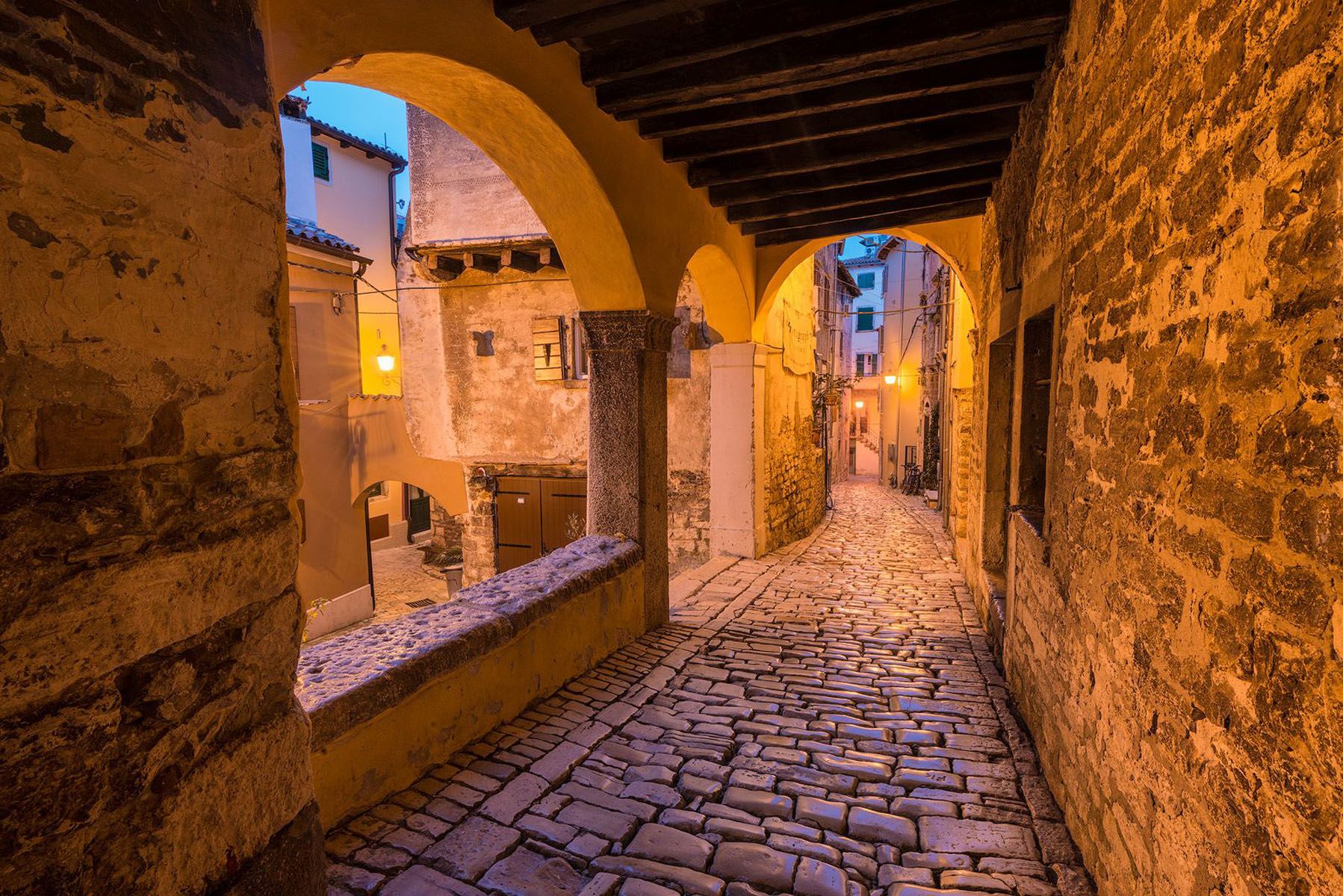
Rovinj introduces a coastal environment shaped by centuries of Mediterranean and Venetian influence. Its old town is a maze of narrow streets, stone buildings, colorful facades, and architectural details that seem designed for close observation.
This is an opportunity to shift from expansive landscape photography toward more intimate images.
Look for repetition in windows and doorways. Photograph the texture of weathered stone. Use converging streets to create depth. Isolate architectural details that might otherwise disappear within a wider scene.
Rovinj also demonstrates why photography trips benefit from exploring a destination rather than simply visiting it. One location can provide an almost endless collection of subjects when you approach it from different perspectives.
The journey through Istria also brings photographers toward Pula, adding another layer of history and architecture to the experience.
Here, Croatia's photographic story becomes less about untouched landscapes and more about the marks people have left on them.
The result is a fascinating contrast: rolling countryside and medieval villages give way to coastal architecture and historic urban environments, all within the same region!
Krka: Following Water Through the Landscape
After exploring Istria's towns and architecture, the journey moves into an entirely different visual world: Krka National Park.
Here, water becomes the central subject.
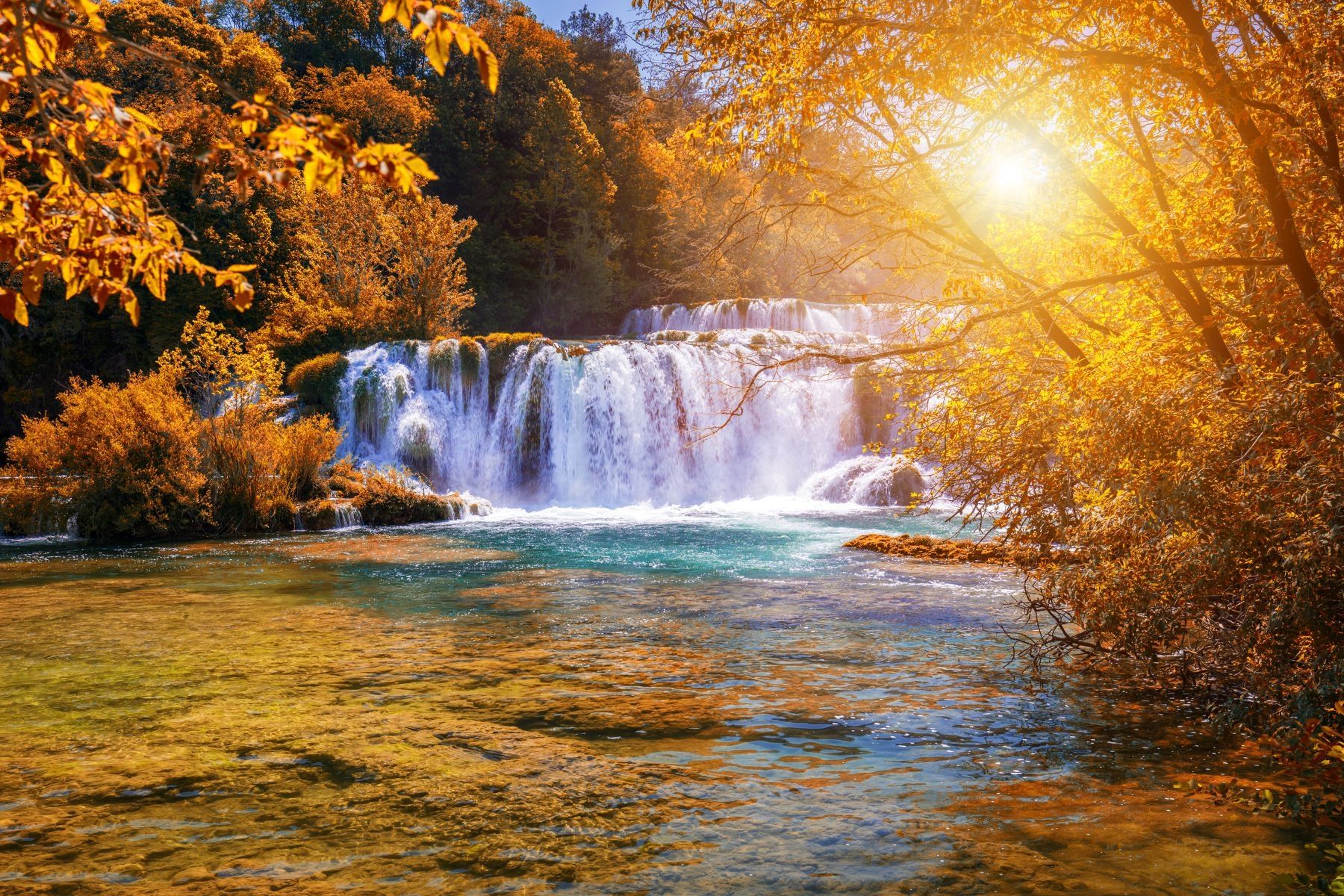
Krka is known for its dramatic cascades, including Skradinski Buk, but the photographic possibilities extend well beyond the waterfalls themselves. Trails wind through the landscape, traditional watermills provide an intriguing connection between nature and human history, and the river creates constantly changing compositions.
For photographers, moving water presents an opportunity to experiment with technique.
A faster shutter speed can preserve individual droplets and the energy of a cascade. A slower shutter speed can transform rushing water into smooth, flowing shapes. A tripod can provide the stability needed for longer exposures, while careful composition can turn a waterfall from a simple scenic subject into an image with depth and movement.
But Krka isn't only about technique.
The surrounding landscape matters just as much!
A waterfall framed by vegetation tells a different story from an isolated cascade. A historic watermill adds context. A path disappearing into the forest can create a sense of scale and invite the viewer into the photograph.
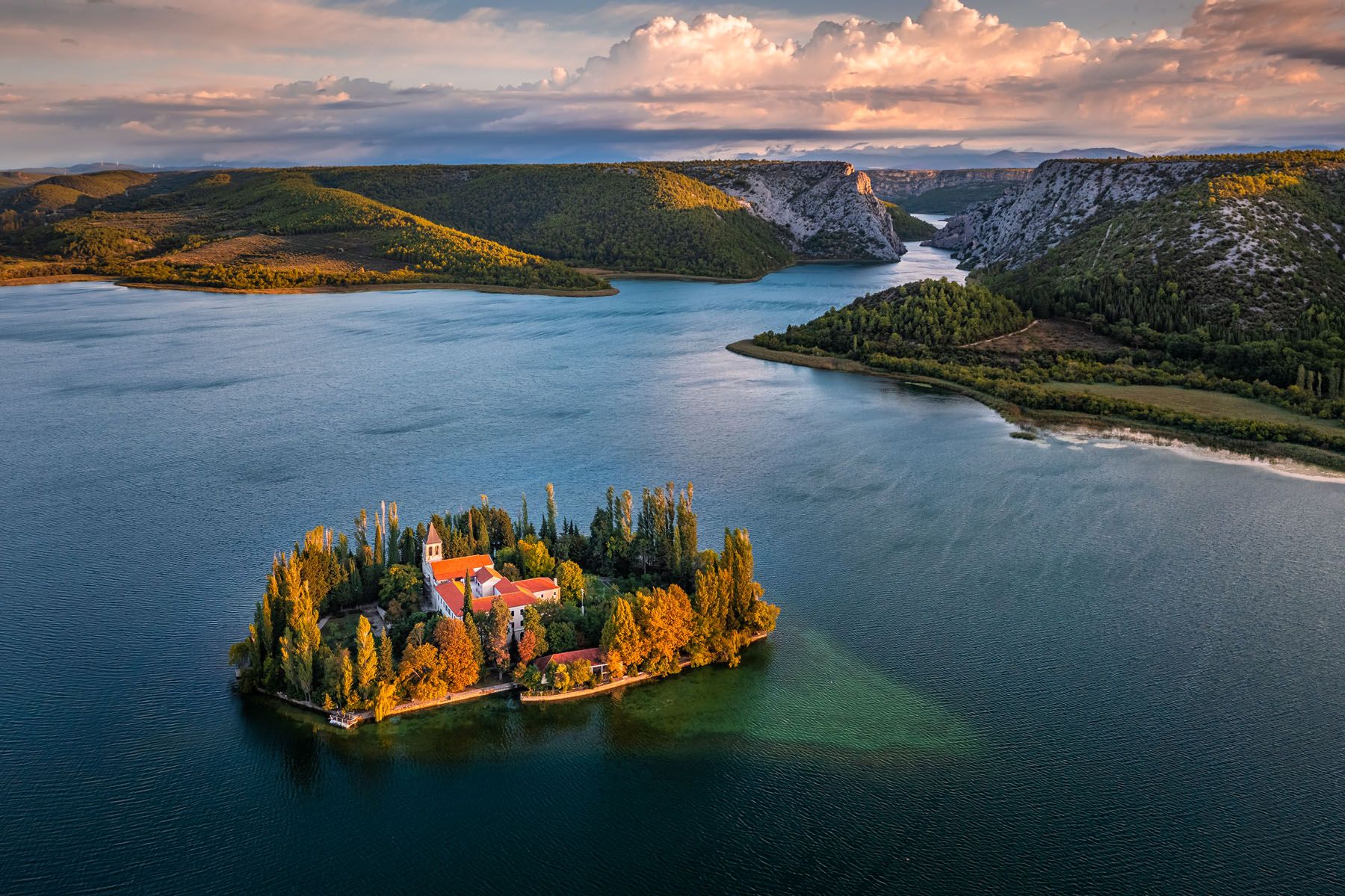
The journey also reaches places where Croatia's natural and cultural histories intersect, including Krka Monastery, positioned above ancient Roman catacombs, and Visovac Island, home to a 15th-century Franciscan monastery.
By this point, the photographic vocabulary of the trip has expanded again: from architecture and panoramas to flowing water, forest, historic structures, and intimate environmental details.

Šibenik: Photographing Centuries of History
The contrast continues in Šibenik, where the subject shifts almost entirely toward architecture.
The city's Cathedral of St. James is a UNESCO World Heritage Site and one of the defining examples of Croatia's historic architecture. For photographers, it offers an opportunity to think about how to translate a complex structure into a compelling image.
Architecture photography isn't simply about photographing an entire building.
Sometimes the strongest image is a small detail: carved stone, an archway, a repeating pattern, a doorway, or the way different surfaces interact.
Other times, stepping back and incorporating the surrounding streets and buildings provides the context that makes the structure meaningful.
Šibenik adds another important layer to the Croatia experience because it demonstrates just how dramatically the photographic subject matter can change within a single journey.
Only a few days earlier, the focus was on hilltop towns and sweeping Istrian landscapes. Then it became waterfalls and rivers. Now, the camera is pointed toward centuries-old stonework and architectural details.
For photographers, that variety is valuable.
It encourages you to move beyond relying on one familiar style and instead adapt your composition, focal length, perspective, and technique to whatever is in front of you.

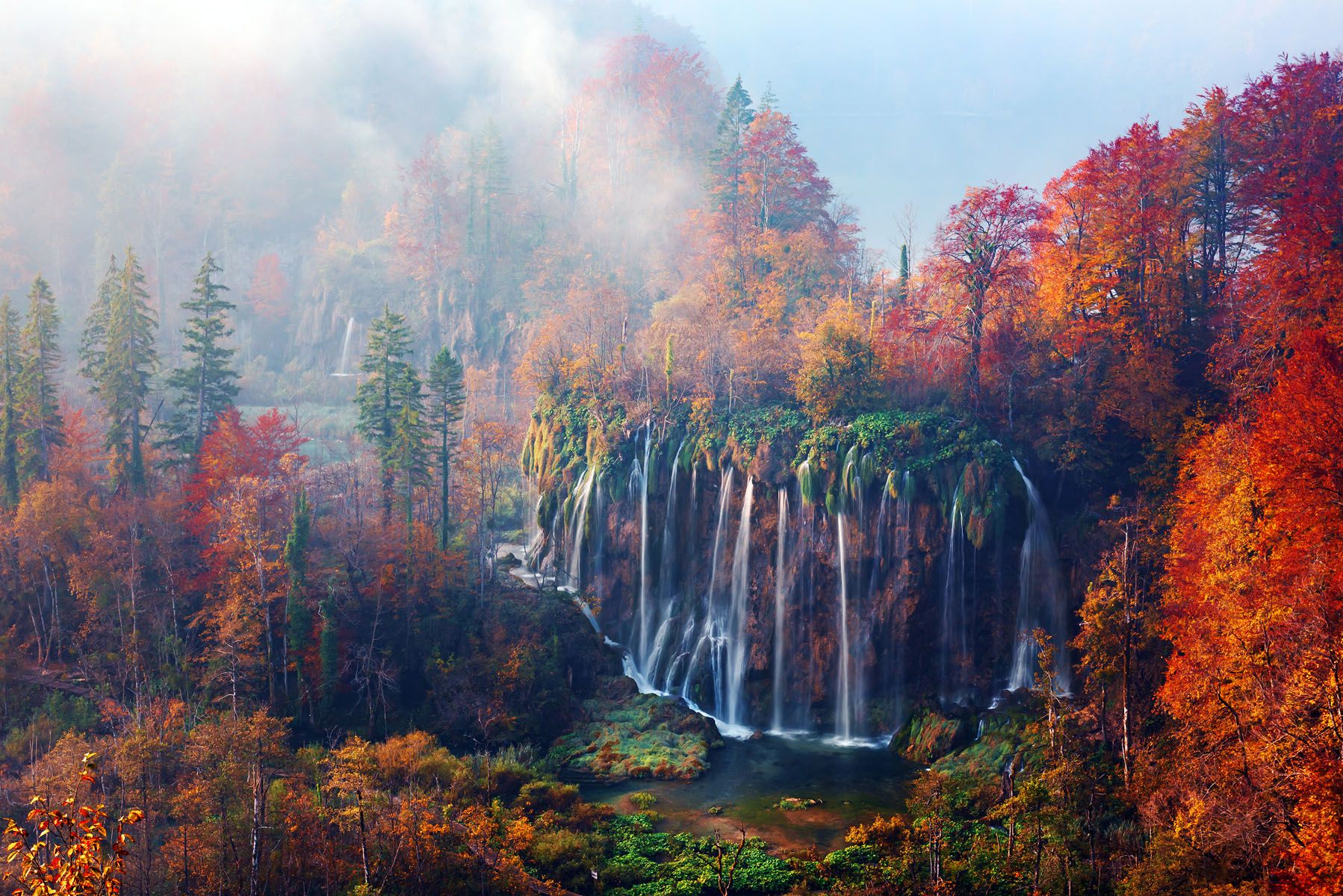
Plitvice Lakes: A World of Water, Forest & Color
Then comes Plitvice Lakes National Park, the visual culmination of the journey.
A UNESCO World Heritage Site, Plitvice combines turquoise lakes, cascading waterfalls, dense forests, caves, wooden walkways, and elevated viewpoints into an extraordinarily varied landscape.
It is also a place where scale becomes important.
One photograph might isolate a single cascade surrounded by greenery. Another might reveal the relationship between multiple lakes and waterfalls. From an overlook, the landscape can become an intricate collection of water, forest, rock, and vegetation.
Plitvice also provides an ideal setting for practicing long-exposure photography and tripod techniques. Slowing the shutter allows moving water to become an intentional compositional element rather than simply something happening within the frame.
Reflections introduce another layer. So does mist. So do the colors of the water themselves.
And because the workshop spends two full days exploring Plitvice, photographers have time to work beyond the first obvious composition. There is an opportunity to revisit ideas, try different techniques, and discover how changing conditions can transform the same landscape!
The final morning provides one more photographic opportunity before the journey back to Zagreb. Depending on conditions, the group may photograph Plitvice again or visit nearby Rastoke, where the Korana River flows through a historic village filled with wooden houses, waterfalls, and cascades.
It is a fitting final chapter: another completely different expression of Croatia's relationship with water.
One Country, Many Ways to Photograph It
The most remarkable thing about photographing Croatia may be how quickly the subject changes.
One day, you're standing among medieval stone streets in Istria. The next, you're photographing waterfalls and traditional watermills in Krka. Then you're studying the architectural details of a UNESCO cathedral in Šibenik. Finally, you're surrounded by turquoise lakes, forests, and cascading water in Plitvice.
Nine days can take a photographer through an extraordinary range of visual environments.
And that variety is precisely what makes Croatia worth photographing.
Rather than spending an entire trip searching for one kind of landscape, photographers can explore architecture, history, water, forests, villages, and expansive scenery, all within a single journey.
The result is more than a collection of photographs from one destination. It is a visual record of a country that refuses to be reduced to a single image.
Croatia may be famous for its blue coastline but look closer and you'll find a country of many layers and a remarkable number of stories waiting to be photographed!
 The Best of Croatia
 Lodge-Based Photo Workshop
From $7,995.00
Up To 10 Guests
Fitness Level 2 - What's This?
Wanna Get Away?
Starts
Current Price:$0.00
Start: Zagreb Airport, Croatia
Led By
Start: Zagreb Airport, Croatia
Led By

Backcountry Journeys
Connecting Passionate People To
Exceptional Experiences.
Exceptional Experiences.
Business Hours:
Mon-Fri, 8AM-4PM MT
928-478-1521
adventure@backcountryjourneys.com
Mon-Fri, 8AM-4PM MT
928-478-1521
adventure@backcountryjourneys.com
arrow_drop_down_circle
Divider Text
All Images & Content Are Property Of Backcountry Journeys Photography Tours, Workshops & Safaris LLC - Copyright 2026


About Us
Receive a Digital Trip Catalog
Find an upcoming photography tour with our interactive catalog.