2025 Travelers' Choice

About Backcountry Journeys
Why Choose Backcountry Journeys
If you're considering a photography trip, hear why Backcountry Journeys delivers the best experience in the industry.Frequently Asked Questions
If you're new to photography trips, or new to BCJ, you can find our common travel questions here.Fitness Levels
Our trips vary on physical intensity, and by reviewing our fitness levels, you can find out which trips may be more challenging, or aligned more closely with your comfort level.Meet The Crew
We've built an amazing team of experienced guides, and dedicated office staff that elevate your travel experience. Get to know their backgrounds, and hear their stories.Loyalty Program
We reward our frequent photo adventurers with exclusive discounts on amazing photography trips.Contact Us
If you need to get in touch with our office staff, or have additional business inquiries, you can find our information here.Refer a Friend
Know someone perfect for one of our tours? Recommend them through this quick form.Stay Up To Date On All Things
Backcountry Journeys
Backcountry Journeys
Our Photography Community
Our Webinars
Our regularly hosted webinars provide photography instruction from our own guides on a wide range of topics.Our Education Portal
Explore our library of articles that cover everything from common questions, to in-depth guides on how to achieve that perfect shot.Community Testimonials
We're proud to foster an amazing group of photo travelers, and here you can find their stories from their past adventures.Resources For Photographers
About Our Company
Resources For Photographers
About Our Company
Stop Chasing Perfect Light: A Photographer’s Guide to Seeing Kauai Differently
Published October 21, 2026
The problem with photographing a place as beautiful as Kauai is that everyone has seen the same picture.
Emerald cliffs rising above turquoise water. A waterfall spilling down a rainforest-covered mountain. Palm trees silhouetted against a fiery Pacific sunset. These are the images that draw photographers to Hawaii’s Garden Isle, and for good reason! But when a landscape is this spectacular, it's surprisingly easy to come home with photographs that look just like everyone else's.
The real challenge of Kauai photography isn't finding a beautiful subject. It's finding a perspective that makes the image your own.
That means learning to work with changing weather instead of waiting for a cloudless sky, using your histogram rather than trusting the camera's automatic exposure, and recognizing when a tighter composition tells a stronger story than an expansive vista. It means understanding that a waterfall, a coastline, and a rainforest each demand a different photographic approach.
Kauai is an ideal place to practice these skills because its landscapes are constantly changing. Clouds move across volcanic ridgelines, trade winds reshape the ocean, and shifting sunlight transforms the island's layers of green into an endless range of tones.
Here are a few ways to approach Kauai landscape photography with a more deliberate eye.
The Green Problem: How to Photograph a Landscape Full of Green
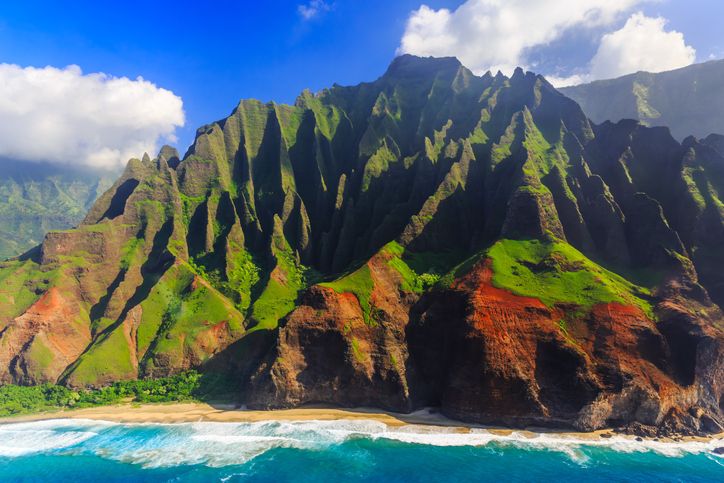
Kauai's lush vegetation is part of what makes the island so visually distinctive. From the ridges of the Nā Pali Coast to the forests surrounding Kōkeʻe State Park, layers of tropical greenery seem to cover nearly every available surface.
For photographers, however, green can be surprisingly difficult to manage.
A scene filled with foliage can quickly become a flat mass of similar colors. Without clear separation between foreground, middle ground, and background, even a dramatic landscape can lose its depth in a photograph.
The solution is to think in terms of tonal separation rather than color alone.
Look for places where light strikes one ridge while another remains in shadow. Pay attention to the contrast between sunlit vegetation and the darker folds of a valley. On an overcast day, watch for subtle variations in the greens rather than expecting dramatic highlights and shadows.
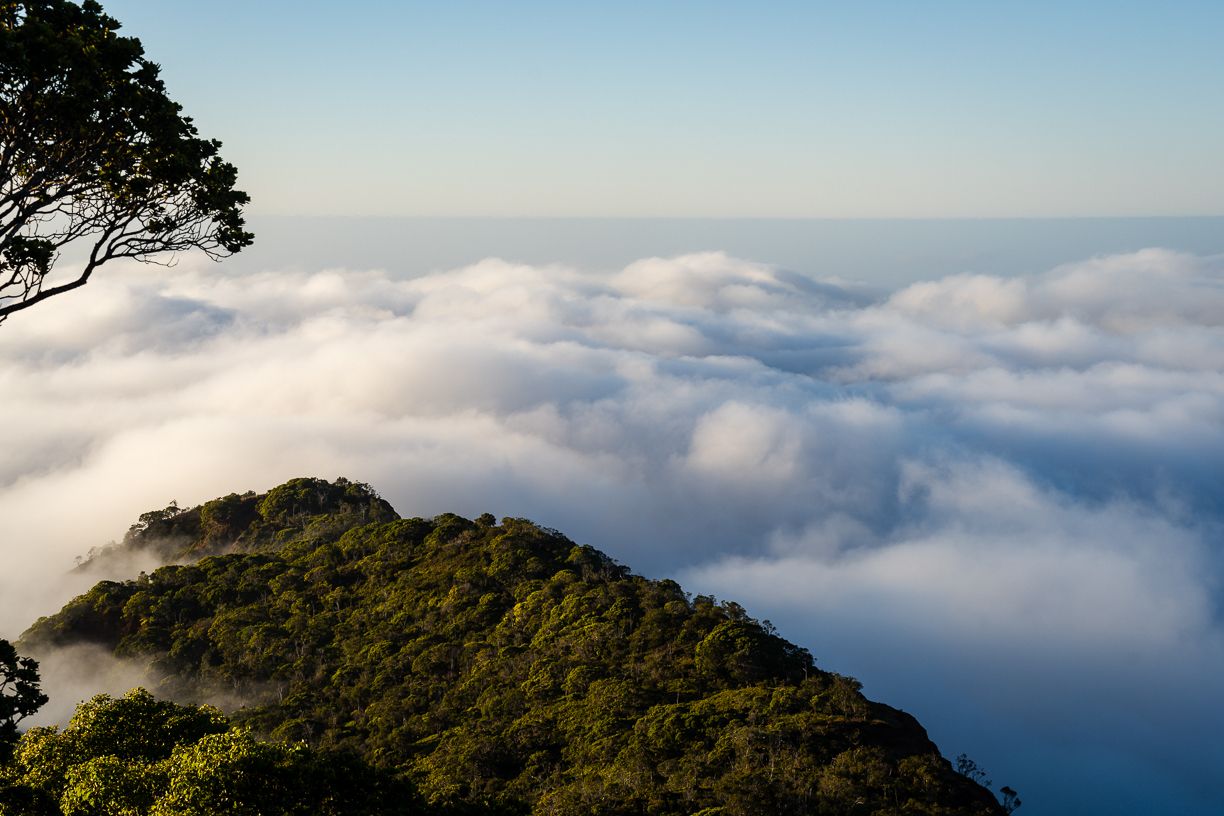
A telephoto lens can be particularly useful here. Instead of capturing an entire valley, use a longer focal length to isolate overlapping ridgelines, repeating patterns in the vegetation, or a single ridge emerging from low clouds. These compressed layers can communicate the depth of the landscape without including every detail.
Your histogram can help you evaluate exposure, but don't assume that a lush scene should always be bright. Protect important highlights in sunlit foliage and watch for shadow detail disappearing into the darkest parts of the frame.
When editing, resist the temptation to push saturation too far. Increasing vibrance and saturation indiscriminately can make tropical greens look artificial and erase the subtle differences that give the landscape its character.
The goal isn't to make Kauai look greener. It's to show the viewer just how much variation exists within that green.
Clouds, Fog, and Rain Aren't 'Photography Failures'
Many photographers arrive in Hawaii hoping for blue skies and golden sunshine. But on an island known for its lush, tropical environment, changing weather can be one of your greatest creative advantages.
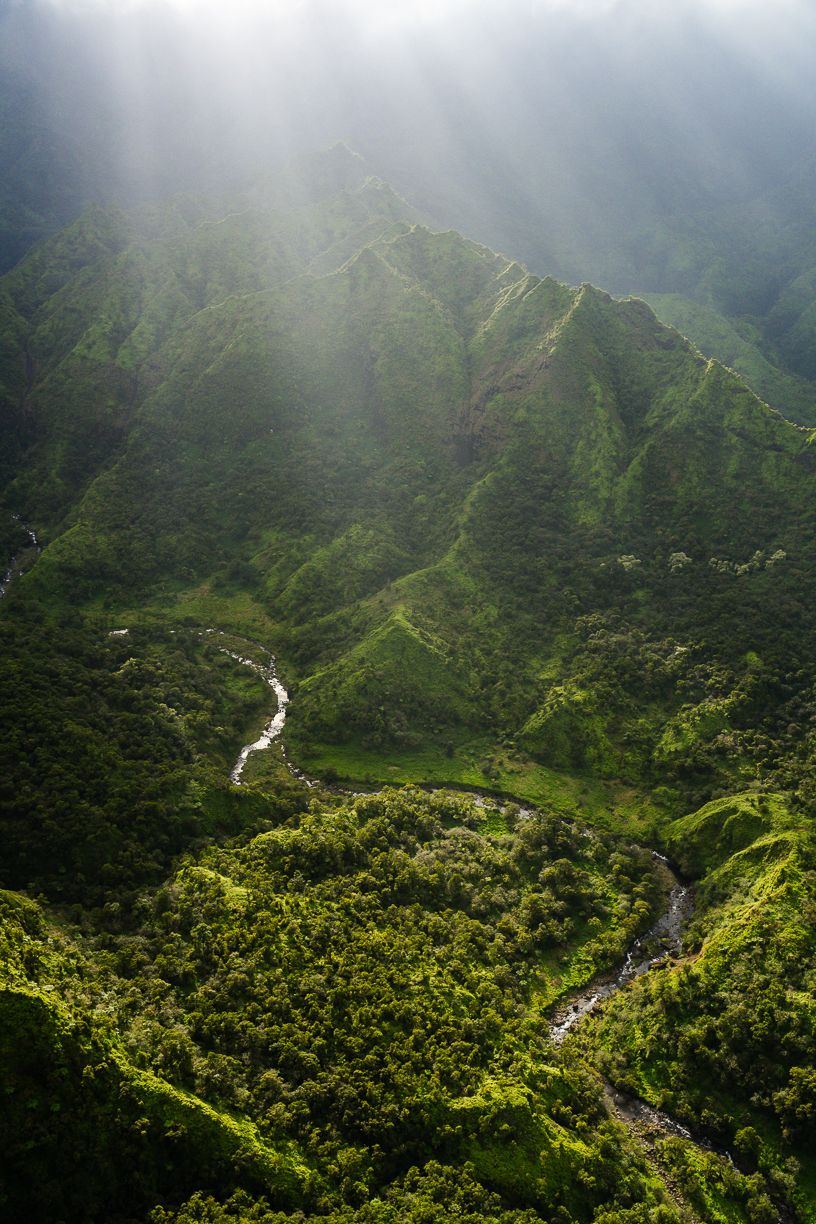
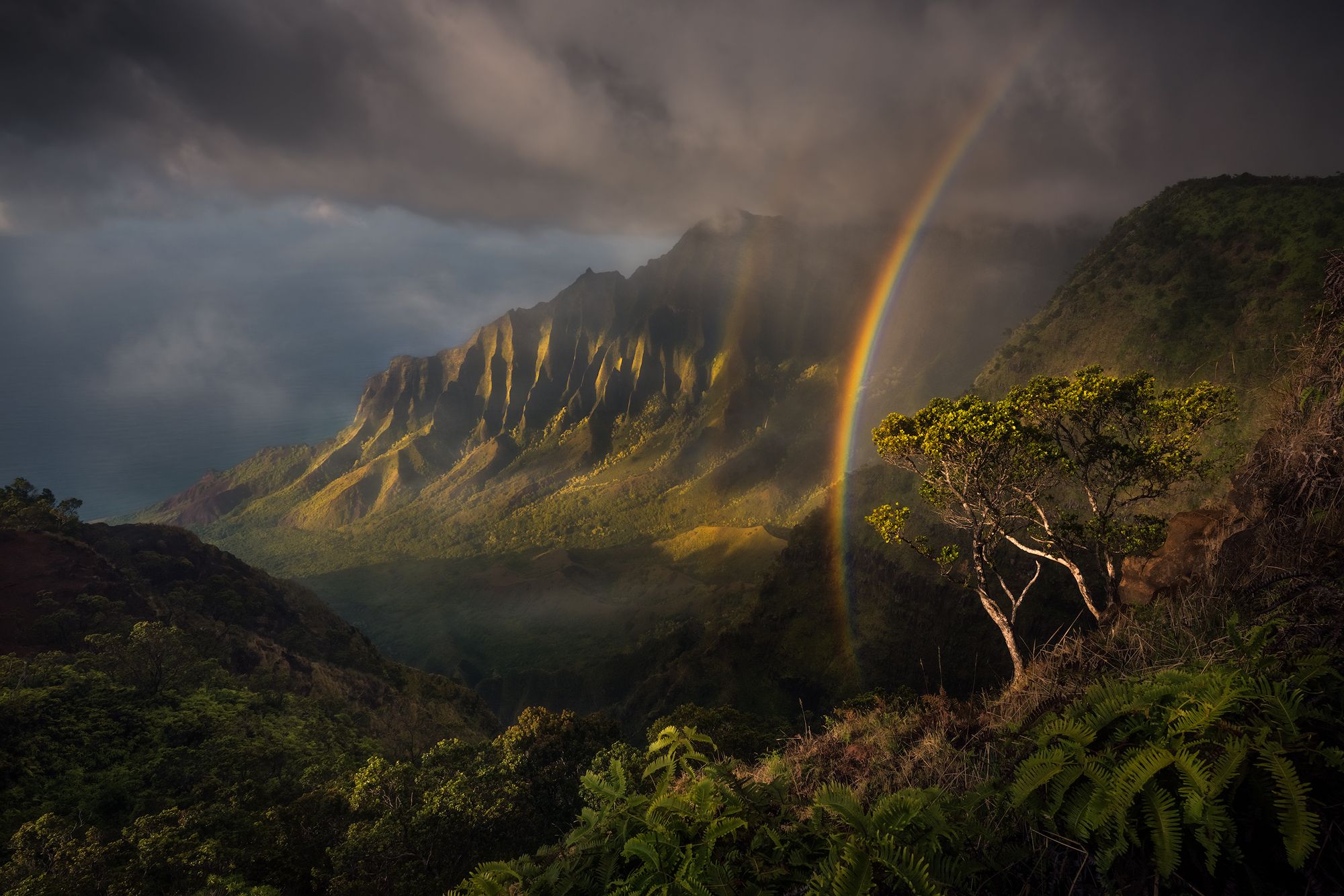
Clouds drifting across the mountains can add depth to an otherwise ordinary composition. Passing showers can create atmospheric layers, while breaks in the clouds can illuminate individual sections of a valley and leave the surrounding landscape in shadow.
Instead of treating weather as an obstacle, treat it as part of the subject.
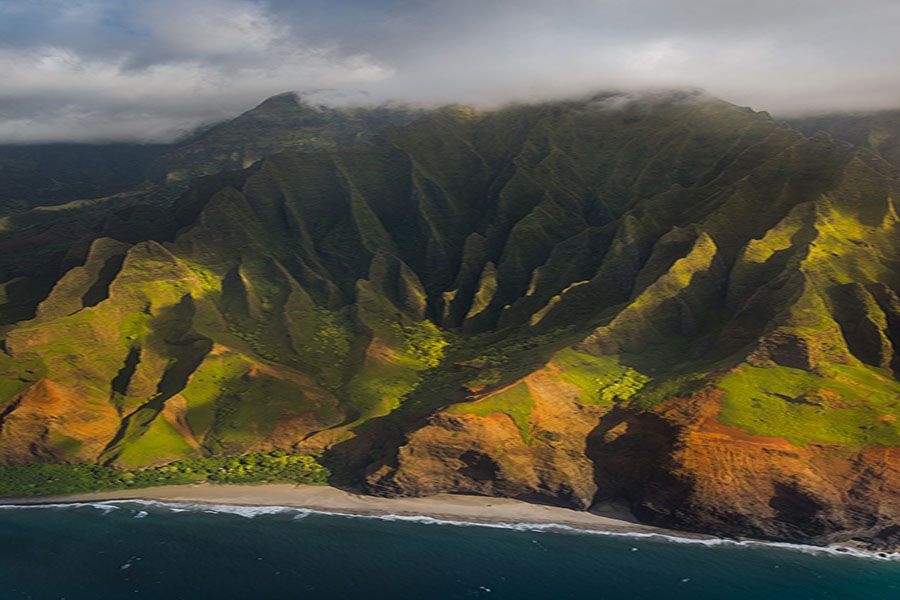
When photographing the Nā Pali Coast, for example, pay attention to how clouds interact with the steep ridgelines. A completely clear sky might leave the upper portion of your frame feeling empty, while low clouds can emphasize the height and scale of the cliffs. If the light changes from minute to minute, keep your composition ready and watch for the moment when illumination separates one ridge from another.
Rain can also create opportunities for more intimate images. Wet foliage often appears richer in color, and moisture can add texture to leaves, tree bark, and forest floors.
Protect your camera with a rain cover, keep a microfiber cloth accessible, and check your front element regularly. A single water droplet on the lens can soften an otherwise sharp image or introduce unwanted flare.
Most importantly, learn to recognize when the conditions are improving rather than waiting for them to become perfect.
The photographer's advantage is adaptability. Anyone can photograph a landscape under ideal conditions. Learning to create compelling images when the weather changes is a skill that follows you home.
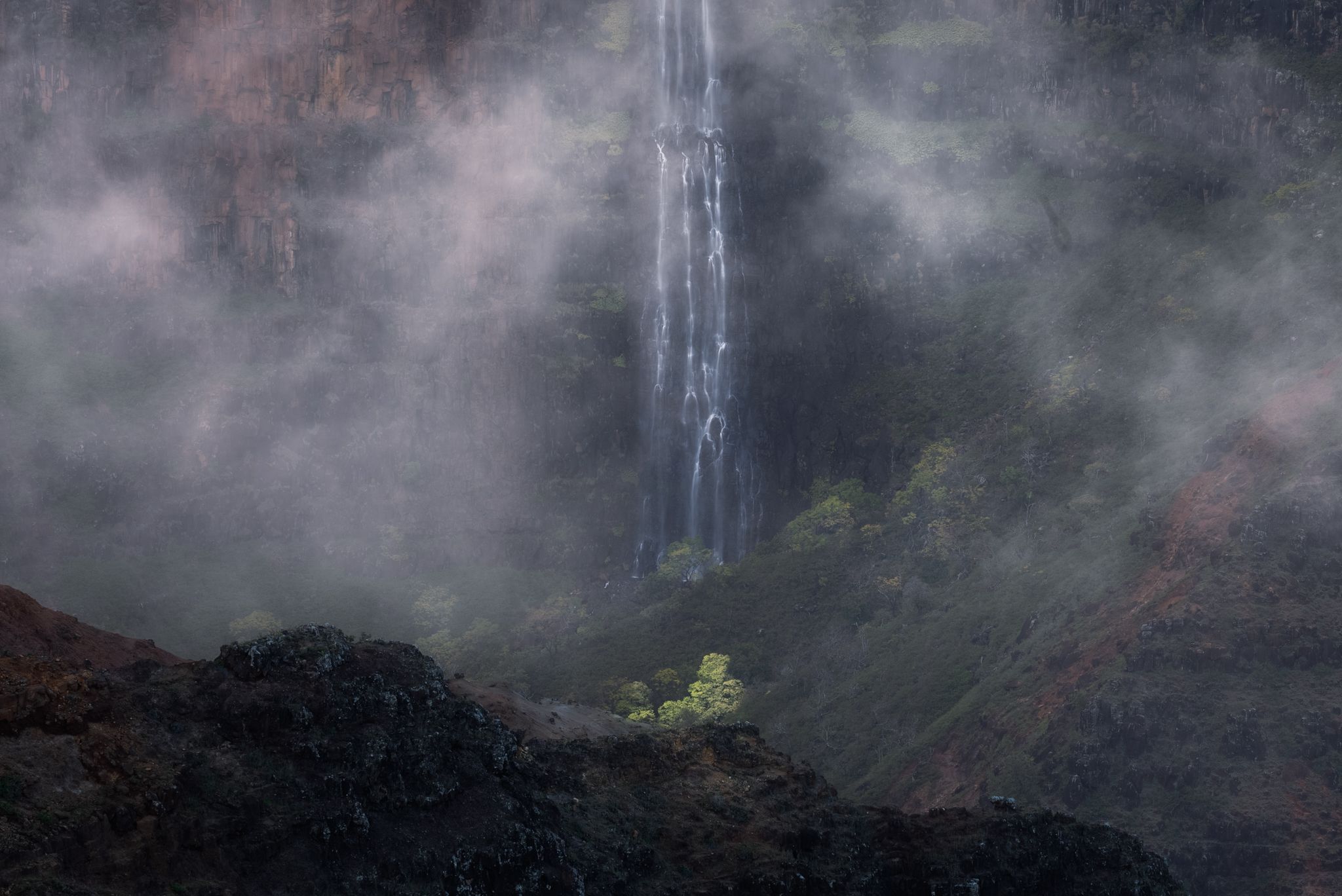
Waterfalls: Why Your Shutter Speed Changes Everything
Kauai's waterfalls present a familiar creative decision for landscape photographers: should the water appear silky and smooth, or should individual droplets remain frozen in motion?
Neither approach is inherently better. The right choice depends on the mood and visual story you want to create.
A slower shutter speed can turn falling water into soft, flowing ribbons. This approach works particularly well when the surrounding rocks and vegetation provide enough detail to contrast with the blurred movement.
A faster shutter speed preserves the structure of the water, revealing individual streams, splashes, and droplets. The resulting image can feel more energetic and immediate.
Try photographing the same waterfall at several shutter speeds rather than committing to a single approach.
For example, experiment with exposures around 1/500 second to preserve motion, then try 1/30 second and a one-second exposure to see how the water changes. These are starting points, not rules; the appropriate settings depend on the waterfall's speed, the available light, and your creative intent.
A tripod helps keep the surrounding landscape sharp during longer exposures. A neutral-density filter can also reduce incoming light, making slower shutter speeds possible in bright conditions.
Watch your highlights, too. Bright white water can lose texture when overexposed, particularly against a darker rainforest background. Check your histogram and adjust exposure as needed.
There's another composition worth considering: don't automatically include the entire waterfall.
A tighter frame emphasizing the way water moves around a rock, disappears behind vegetation, or contrasts with dark stone can be more visually compelling than a wide image of the whole cascade.
The lesson extends beyond waterfalls. Whenever you're photographing movement, your shutter speed is part of the storytelling process.
A Helicopter Changes More Than Your Viewpoint
Photographing Kauai from the air introduces a completely different way of seeing the landscape.
From the ground, your compositions are shaped by foreground objects, accessible viewpoints, and the direction you're facing. From above, those familiar landscapes become patterns of ridgelines, valleys, waterfalls, and coastlines.
The shift can be liberating, but aerial photography also presents technical challenges that are easy to underestimate.
During a doors-off helicopter flight, you may be dealing with wind, vibration, rapid changes in perspective, and limited time to compose each image. You won't have the luxury of setting up a tripod or carefully arranging a foreground.
Preparation matters.
Before your flight, make sure you understand your camera's controls and can adjust shutter speed, aperture, and ISO without navigating complicated menus. Use a secure camera strap and follow your flight operator's equipment and safety requirements.
A fast shutter speed is particularly important. Depending on the aircraft's movement, conditions, and focal length, you may need speeds around 1/1000 second or faster to minimize motion blur. Don't be afraid to raise your ISO when necessary to maintain that speed.
Consider using continuous autofocus and a burst mode if the scene changes quickly, but avoid assuming that more frames automatically produce better results. Your goal is still to recognize strong compositions.
Look for patterns rather than simply pointing the camera at the most dramatic view. Repeating ridgelines can create rhythm, while a waterfall cutting through dense vegetation can become a natural leading line. The contrast between the ocean and the island's rugged interior may provide a strong visual anchor.
Also, be selective with your focal length! A wide-angle lens can communicate the scale of the landscape, while a moderate telephoto can isolate distinctive shapes and compress layers of terrain.
The most important preparation may be mental: decide what you want to photograph before you take off, then stay flexible enough to respond to what appears beneath you.
Find a New Perspective on Kauai With Backcountry Journeys
Photographing Kauai is an opportunity to develop more than a collection of tropical landscape images. It's an opportunity to become a more adaptable photographer.
The island encourages you to work with changing weather, recognize subtle differences in light, experiment with shutter speed, and find compositions beyond the obvious. From the sculpted cliffs of the Nā Pali Coast to the waterfalls and ridgelines of Waimea Canyon, every environment presents a different set of creative decisions.
On the Kauai: The Garden Isle Photo Workshop, Backcountry Journeys provides opportunities to explore these photographic challenges with professional instruction and a small group of fellow photographers. The experience includes landscape photography sessions, waterfall opportunities, and a doors-off helicopter flight that opens up an entirely different perspective on the island.
You may arrive hoping to capture the perfect Hawaiian sunrise. But the more lasting reward might be learning to recognize a compelling image when the light isn't perfect, the weather changes, or the familiar composition no longer works.
Because the best landscape photographers aren't simply the ones who find the most beautiful places.
They're the ones who learn how to see them differently.
 Kauai: The Garden Isle
 Lodge-Based Photo Workshop
From $8,995.00
Up To 7 Guests
Fitness Level 1 - What's This?
Wanna Get Away?
Starts
Current Price:$0.00
Start: Lihue, HI
Led By
Start: Lihue, HI
Led By

Backcountry Journeys
Connecting Passionate People To
Exceptional Experiences.
Exceptional Experiences.
Business Hours:
Mon-Fri, 8AM-4PM MT
928-478-1521
adventure@backcountryjourneys.com
Mon-Fri, 8AM-4PM MT
928-478-1521
adventure@backcountryjourneys.com
arrow_drop_down_circle
Divider Text
All Images & Content Are Property Of Backcountry Journeys Photography Tours, Workshops & Safaris LLC - Copyright 2026


About Us
Receive a Digital Trip Catalog
Find an upcoming photography tour with our interactive catalog.