2025 Travelers' Choice

Stay Up To Date On All Things
Backcountry Journeys
Backcountry Journeys
Our Photography Community
Our Webinars
Our regularly hosted webinars provide photography instruction from our own guides on a wide range of topics.Our Education Portal
Explore our library of articles that cover everything from common questions, to in-depth guides on how to achieve that perfect shot.Community Testimonials
We're proud to foster an amazing group of photo travelers, and here you can find their stories from their past adventures.About Backcountry Journeys
Why Choose Backcountry Journeys
If you're considering a photography trip, hear why Backcountry Journeys delivers the best experience in the industry.Frequently Asked Questions
If you're new to photography trips, or new to BCJ, you can find our common travel questions here.Fitness Levels
Our trips vary on physical intensity, and by reviewing our fitness levels, you can find out which trips may be more challenging, or aligned more closely with your comfort level.Meet The Crew
We've built an amazing team of experienced guides, and dedicated office staff that elevate your travel experience. Get to know their backgrounds, and hear their stories.Loyalty Program
We reward our frequent photo adventurers with exclusive discounts on amazing photography trips.Contact Us
If you need to get in touch with our office staff, or have additional business inquiries, you can find our information here.Refer a Friend
Know someone perfect for one of our tours? Recommend them through this quick form.Resources For Photographers
About Our Company
Ultimate Namibia Photo Safari
Ultimate Namibia Photo Safari
Lodge-Based Photo Workshop
Upcoming Departures
arrow_drop_down_circle
Divider Text
[Block//Start Date %M j%+0] - [Block//End Date %M j, Y%+0]
[Block//Web Spots Left]
Trip Leader(s)
[Block//Trip Leader #1]
[Block//Trip Leader #2]
Starting From [Block//Current Price]
Single Supplement: +$1,995.00
[Block//Online Availability]
Deposit: $4,000.00
Start/End
Windhoek, Namibia / Windhoek, Namibia
Length
11 Days/10 Nights
Fitness Level
Level 1 - What's This?
Group Size
Up To 8 Guests
Highlights
Photograph the iconic red dunes of Sossusvlei and the ancient camel thorn trees of Dead Vlei during the golden light of sunrise and sunset.
Experience Namibia's spectacular diversity, from the Skeleton Coast and Sandwich Harbour to the granite peaks of Spitzkoppe and the vast plains of Etosha National Park.
Capture an incredible variety of African wildlife, including elephants, lions, black rhinos, giraffes, zebras, cheetahs, leopards, hyenas, and an abundance of birdlife.
Stay in exceptional lodges throughout the journey, including accommodations overlooking Etosha's famous floodlit waterhole and the renowned Okonjima Nature Reserve, home of the AfriCat Foundation.
Trip Description:
Namibia is a country of extraordinary contrasts. Towering red sand dunes rise above ancient desert valleys, rugged granite mountains stand alone on vast open plains, and the Atlantic Ocean meets one of the driest deserts on Earth. Farther north, elephants, lions, giraffes, and rhinos roam the savannas and gather around waterholes beneath immense African skies. Few destinations offer such an incredible variety of photographic subjects, and even fewer combine world-class landscape and wildlife photography quite like Namibia.
On this 11-day photography adventure, we'll explore some of southern Africa's most remarkable landscapes and wildlife destinations, traveling from the towering dunes of the Namib Desert to the wildlife-rich plains of Etosha National Park. Along the way, we'll photograph ancient desert trees, dramatic coastal scenery, beautiful granite formations, and an extraordinary variety of African wildlife. It's a journey designed for photographers who love both landscapes and wildlife, with opportunities to create a remarkably diverse portfolio.
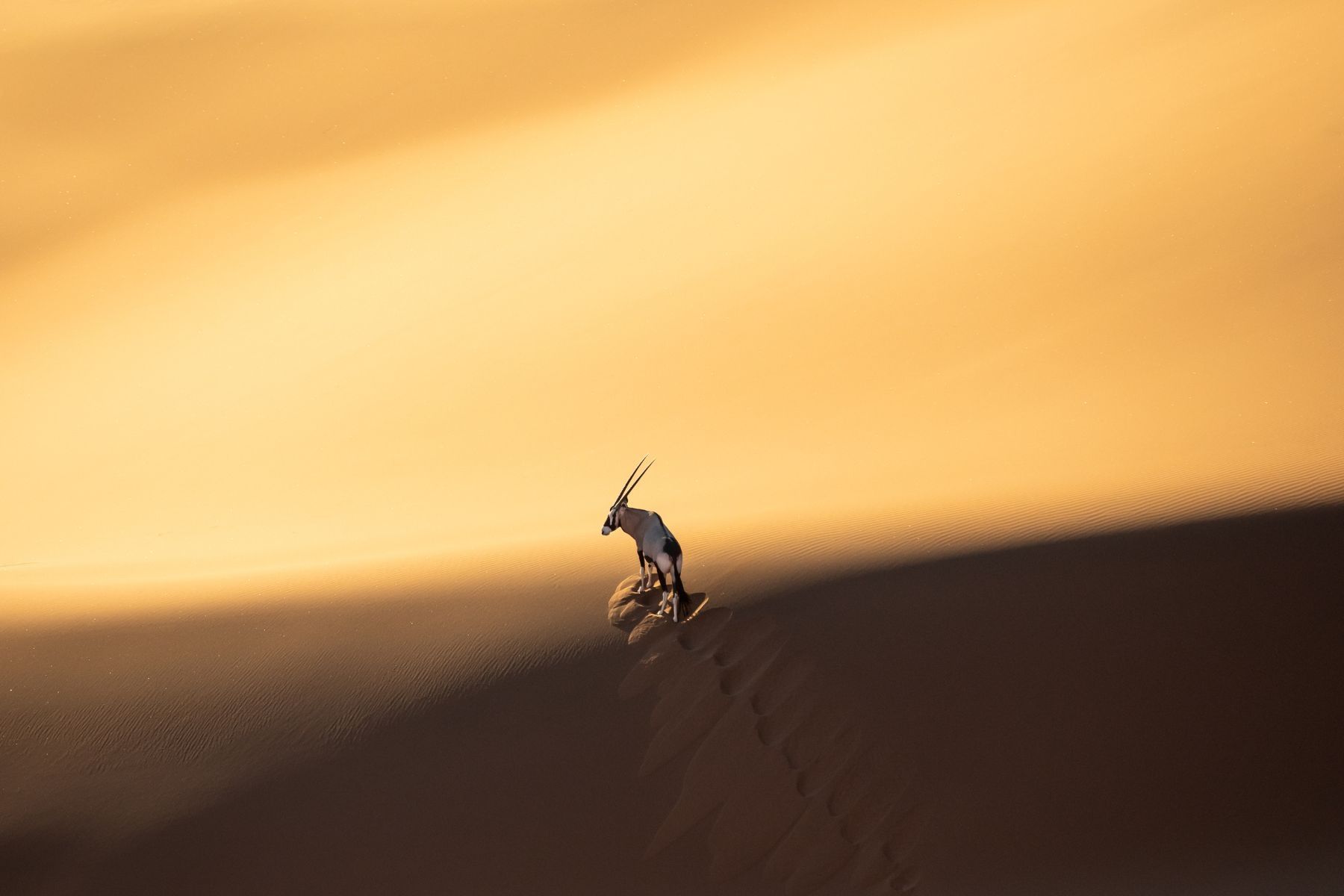
Our adventure begins in the Namib Desert, home to some of the tallest and most recognizable sand dunes in the world. At Sossusvlei and Dead Vlei, we'll photograph the extraordinary contrast of bright orange dunes, white clay pans, and the dark silhouettes of ancient camel thorn trees. The simplicity of these landscapes is part of what makes them so compelling. As the sun rises and falls, shadows move across the dunes, revealing graceful curves, sharp ridgelines, and endless opportunities for intimate compositions and abstracts.
From the desert interior, we'll make our way to Namibia's wild Atlantic coastline. Here, the cold waters of the Benguela Current help create the fog that sustains life along the edge of the Namib Desert. We'll explore the remarkable landscapes of Sandwich Harbour, where immense sand dunes descend directly toward the ocean, and photograph the rugged coastline, sweeping sand formations, and abundant birdlife of the Walvis Bay region. We'll also visit Cape Cross, home to one of the largest Cape fur seal colonies in the world, before continuing inland to the granite peaks of Spitzkoppe. These ancient rock formations rise dramatically above the surrounding plains, offering exceptional opportunities for landscape photography, especially in the warm light of sunrise and sunset.
As we travel north, our attention turns to wildlife. Etosha National Park is one of Africa's great wildlife photography destinations, known for its expansive plains, remarkable concentrations of animals, and productive waterholes. Elephants, giraffes, zebras, springbok, oryx, lions, and rhinos are among the many species we'll hope to encounter. What makes Etosha especially rewarding for photographers is its relatively open terrain. Sparse vegetation and expansive plains often provide unobstructed views, clean backgrounds, and beautiful opportunities to photograph animals in their natural environment. During the dry season, wildlife gathers around the park's waterholes, where patient photographers may be rewarded with close encounters, fascinating behavior, and interactions between species. We'll spend several days exploring Etosha and the neighboring Onguma Private Reserve, taking advantage of changing light and wildlife activity throughout the region.
Our final destination is Okonjima Nature Reserve, home to the AfriCat Foundation and its important conservation work with Namibia's large carnivores. Here, we'll have opportunities to photograph wildlife in a beautiful private reserve while learning more about the challenges of protecting predators and their habitats.
Throughout the journey, we'll take a photographer's approach to exploring Namibia, making the most of early morning and late afternoon light, spending time at productive locations, and adjusting our plans when conditions and wildlife activity present new opportunities. With a small group and professional photographic guidance, there will be plenty of time to work on composition, technique, and creative storytelling.
What makes Ultimate Namibia so special is the sheer diversity of the experience. One day you might be photographing the clean, sweeping lines of a desert dune. The next, you're working with dramatic coastal fog, towering granite peaks, or a herd of elephants approaching a waterhole. For photographers who appreciate the beauty of the natural world in all its forms, Namibia offers an extraordinary combination of subjects, landscapes, and experiences that few places can match.
What's Included
All listed meals and non-alcoholic beverages during the workshop
All transportation during the workshop
All lodging during the workshop
Airport transfers
All permits and park fees
Professional photography guiding and instruction
Gratuity for hotel, restaurant, service staff, and driver(s)
What's Not Included
Flights to and from Windhoek, Namibia (WDH)
Meals not listed as included on the itinerary
Lodging outside workshop dates
Alcoholic beverages
Souvenirs and personal items
Gratuity for photography guide(s). Please refer to our FAQ section for more details about gratuities
Trip Insurance & Medical Evacuation Insurance (required) - see plans here.
Details
- Final Balance Due 180 days prior to Trip Start
- Specialized Itinerary terms & conditions apply. Please see our Cancellation / Transfer policy on our Frequently Asked Questions page.
- Trip Insurance Required


Trip Itinerary
Trip Itinerary
Most meals included – (B,L,D) denotes Breakfast, Lunch, Dinner
Day 1 – Arrival in Windhoek (D)
Welcome to Namibia! Upon arriving at Hosea Kutako International Airport, we'll transfer to our hotel in Windhoek, the country's capital and largest city. After settling in, we'll gather for a welcome dinner to meet our fellow photographers, discuss the journey ahead, and prepare for our adventure into the Namib Desert.
Day 2 – Journey into the Namib Desert (B, L, D)
After breakfast, we'll begin our journey southwest toward Sossusvlei and the heart of the Namib Desert. The drive introduces us to Namibia's remarkable scenery as we cross mountain passes, expansive gravel plains, and increasingly arid landscapes.
The Namib is considered one of the world's oldest deserts, and its dramatic scenery is unlike anything else in Africa. By afternoon, we'll arrive at our accommodations near Sossusvlei, our base for exploring the region's famous dunes. After settling in, we'll head out for our first photography session if time and conditions allow, looking for beautiful evening light across the surrounding desert.
Day 3 – Sossusvlei & Dead Vlei (B, L, D)
Today is dedicated to one of the most extraordinary landscape photography locations in the world. We'll get an early start to photograph the dunes of Sossusvlei as the first sunlight reaches their towering ridgelines. The low angle of the sun creates incredible contrasts between illuminated sand and deep shadows, revealing the elegant shapes and textures of the desert.
One of our primary destinations is Dead Vlei, an ancient clay pan surrounded by immense orange dunes. Here, the dark skeletons of centuries-old camel thorn trees stand against the bright white ground, creating some of Namibia's most recognizable and compelling compositions.
We'll explore additional locations around Sossusvlei, with opportunities to photograph sweeping dune landscapes, intimate sand patterns, and the remarkable colors of the Namib. During the middle of the day, we'll return to the lodge for a break before heading back out to take advantage of the evening light.
Day 4 – Swakopmund & the Skeleton Coast (B, L, D)
Leaving Sossusvlei behind, we'll travel west toward the Atlantic Ocean, passing through the rugged landscapes of the Gaub and Kuiseb Canyons. The scenery changes dramatically along the way as the mountains and desert plains gradually give way to Namibia's wild coastline.
Our destination is Swakopmund, a charming coastal town known for its German colonial architecture and unusual setting between the desert and the sea. The influence of the cold Atlantic is immediately apparent here, where coastal fog frequently rolls inland across the desert.
After checking into our hotel, we'll have time to relax and enjoy the coastal atmosphere before continuing our photographic exploration the following morning.
Day 5 – The Dunes of Sandwich Harbour (B, L, D)
Today we'll explore one of Namibia's most spectacular coastal landscapes during a guided 4WD excursion to Sandwich Harbour.
This remarkable stretch of coastline is where the enormous dunes of the Namib Desert descend toward the Atlantic Ocean. The meeting of sand, sea, and sky creates a landscape of extraordinary scale, with constantly changing light and endless opportunities for photography.
We'll travel along the coast in specialized vehicles, stopping at elevated viewpoints and scenic locations to photograph the towering dunes and ocean below. Along the way, we'll also explore the Walvis Bay region, where shallow lagoons and salt pans attract a wonderful variety of coastal birds, including flamingos and other shorebirds.
The combination of immense dunes, coastal textures, wildlife, and dramatic scenery makes this one of the most memorable landscape photography days of the workshop.
Day 6 – Cape Cross & Spitzkoppe (B, L, D)
This morning we'll travel north along the coast to Cape Cross, home to an enormous breeding colony of Cape fur seals. Thousands of seals gather along this stretch of shoreline, offering wonderful opportunities to photograph animal behavior, interactions, and the rugged coastal environment.
After our visit, we'll turn inland toward Spitzkoppe, one of Namibia's most distinctive natural landmarks. Rising abruptly from the surrounding desert plains, these ancient granite peaks are remnants of a much larger geological formation shaped by millions of years of erosion.
Spitzkoppe is a wonderful place for landscape photography. Massive granite domes, natural arches, weathered rock surfaces, and isolated trees provide countless compositional possibilities. We'll spend the afternoon exploring this remarkable area, finishing with sunset photography as the warm evening light illuminates the granite peaks.
Day 7 – Etosha National Park (B, L, D)
Today we'll head north toward Etosha National Park, one of Africa's premier wildlife destinations and a highlight of our journey.
Etosha is centered around an immense salt pan, a vast, pale expanse that dominates the landscape and gives the park much of its distinctive character. During the dry season, wildlife concentrates around permanent and seasonal waterholes, creating excellent opportunities to observe and photograph animals as they come to drink.
After entering the park through Anderson Gate, we'll begin exploring the southern waterholes. Elephants, giraffes, zebras, springbok, oryx, and numerous other species are commonly encountered in this region, while lions and rhinos are among the larger animals we'll hope to photograph.
One of Etosha's greatest advantages for photographers is its open landscape. With relatively sparse vegetation and long sightlines, we're often able to photograph animals against uncluttered backgrounds, making it an excellent destination for both intimate portraits and wider environmental compositions.
We'll spend the afternoon exploring the park before heading to our accommodations in the Etosha region.
Day 8 – Wildlife Photography in Etosha (B, L, D)
We'll devote the entire day to wildlife photography in Etosha National Park, concentrating on productive waterholes and areas with recent wildlife activity.
Water is central to life in Etosha, and during the dry season, the park's waterholes can attract an extraordinary variety of wildlife. It's not unusual to see several species sharing the same waterhole, creating wonderful opportunities to photograph animal behavior and interactions.
We'll take our time throughout the day, watching for interesting activity and working with the changing light. The park's open plains can provide beautifully clean backgrounds, while dust, warm morning light, and expansive African skies add atmosphere to our images.
Whether we're photographing elephants approaching a waterhole, giraffes moving across the plains, or predators resting in the shade, our goal is to spend quality time with the wildlife we encounter.
As the day comes to a close, we'll return to our accommodations after another rewarding day of wildlife photography.
Day 9 – Across Etosha to Onguma (B, L, D)
Today we'll continue our exploration of Etosha, gradually making our way from the western side of the park toward the eastern region.
Rather than treating the journey simply as a transfer, we'll spend much of the day on a game drive, stopping at productive waterholes and watching for wildlife along the way. Different areas of Etosha support a wonderful variety of animals and birds, and traveling across the park gives us the opportunity to experience its changing habitats.
The eastern region of Etosha offers its own distinctive scenery and wildlife opportunities, with open grasslands, mopane woodland, and numerous waterholes attracting a variety of species.
By late afternoon, we'll arrive at Onguma Private Reserve, located along Etosha's eastern boundary. Onguma is known for its beautiful natural setting and excellent wildlife viewing opportunities. Depending on our arrival time and scheduled activities, we may have an opportunity for additional wildlife photography before dinner.
Day 10 – Okonjima Nature Reserve (B, L, D)
After breakfast, we'll leave the Etosha region and travel south toward Okonjima Nature Reserve, our final destination in Namibia.
Set among rolling hills, open savanna, and rugged mountains, Okonjima is home to the renowned AfriCat Foundation, which has played an important role in the conservation of Namibia's large carnivores. The reserve supports a variety of wildlife and is especially well known for its leopard population.
After arriving and settling into our accommodations, we'll have an opportunity to explore the reserve during a scheduled wildlife activity. Our visit offers a chance to learn about the challenges facing Namibia's large carnivores while photographing wildlife in a beautiful natural setting.
Day 11 – Final Wildlife Photography & Departure (B)
We'll begin our final morning with one last wildlife activity at Okonjima, making the most of the early light before returning for breakfast.
Afterward, we'll begin our journey back to Windhoek and Hosea Kutako International Airport, where our Namibian photography adventure comes to an end.
Over the past 11 days, we'll have experienced an incredible cross-section of Namibia, from the ancient dunes of the Namib Desert and the wild Atlantic coastline to the granite peaks of Spitzkoppe and the wildlife-filled plains of Etosha. Few destinations offer such a remarkable combination of landscape and wildlife photography, and we hope you'll return home with an unforgettable collection of images and memories.
Please note that the exact sequence of the itineraries on all photography trips will be based on weather and lighting conditions. The goal on these trips is to make sure we are at the right place at the right time for the perfect light on our subjects. Also, itineraries can change for a variety of other circumstances including floods, forest fires, national park closures, road closures, and more. Due to the nature of wildlife and landscape photography, we do not guarantee any specific sightings or specific compositions.
Physical Requirements
This trip involves moderate physical activity, including short hikes and photography sessions, with most trails being accessible and well-maintained. The terrain varies from flat coastal areas to more rugged, rocky regions. Participants should be prepared for long days, including extended periods in the vehicle while traveling between locations. One portion of the trip includes hiking up and down a sand dune, which is more strenuous than a typical hike due to the soft, shifting sand and elevation changes. Exposure to sun and variable weather conditions is expected, so sun protection and appropriate clothing layers for hot days and cooler mornings and evenings are recommended.
Why Choose Backcountry Journeys?
UNPARALELLED
PHOTOGRAPHY
TRIPS
PHOTOGRAPHY
TRIPS
arrow_drop_down_circle
Divider Text
Explore over 100 worldwide photo tours and workshops tailored to photographers of all skill levels, from iconic U.S. National Parks to Africa's untamed savannahs.
THE BEST TEAM
IN THE
BUSINESS
IN THE
BUSINESS
arrow_drop_down_circle
Divider Text
We're proud to offer unmatched photography trips led by exceptional instructors who not only excel in photography but also serve as expert guides.
WORLD-CLASS
PHOTOGRAPHY
COMMUNITY
PHOTOGRAPHY
COMMUNITY
arrow_drop_down_circle
Divider Text
Join the Backcountry Journeys Tribe, where shared adventures in breathtaking locations foster lasting connections with fellow photographers in a warm, inclusive atmosphere.


[Block//Review]
[Block//Trip Reviewer//First Name] - [Block//Date Of Review %n/j/Y%+0]
Verified Guest

Worry Free Travel Guarantee!
Worry Free Travel Guarantee!

HERE’S THE DEAL
We offer one of the most rock solid guarantees in the travel industry - our worry free travel, peace of mind guarantee to you!We’re so confident that the Photography Trips we offer will not only meet but exceed the lofty expectations set forth on our website – if your trip experience does not 100% match the promises laid forth on our website we will gladly give you a credit toward a future trip.
Natural events such as wildlife & weather are certainly out of our control but every aspect of the trip including logistics, accommodations, vehicles, itinerary & your expert trip leaders will match the lofty promises we’ve made on the site – we guarantee it!

Backcountry Journeys
Connecting Passionate People To
Exceptional Experiences.
Exceptional Experiences.
Business Hours:
Mon-Fri, 8AM-4PM MT
928-478-1521
adventure@backcountryjourneys.com
Mon-Fri, 8AM-4PM MT
928-478-1521
adventure@backcountryjourneys.com
arrow_drop_down_circle
Divider Text
All Images & Content Are Property Of Backcountry Journeys Photography Tours, Workshops & Safaris LLC - Copyright 2026


About Us
Receive a Digital Trip Catalog
Find an upcoming photography tour with our interactive catalog.