2025 Travelers' Choice

Stay Up To Date On All Things
Backcountry Journeys
Backcountry Journeys
Our Photography Community
Our Webinars
Our regularly hosted webinars provide photography instruction from our own guides on a wide range of topics.Our Education Portal
Explore our library of articles that cover everything from common questions, to in-depth guides on how to achieve that perfect shot.Community Testimonials
We're proud to foster an amazing group of photo travelers, and here you can find their stories from their past adventures.About Backcountry Journeys
Why Choose Backcountry Journeys
If you're considering a photography trip, hear why Backcountry Journeys delivers the best experience in the industry.Frequently Asked Questions
If you're new to photography trips, or new to BCJ, you can find our common travel questions here.Fitness Levels
Our trips vary on physical intensity, and by reviewing our fitness levels, you can find out which trips may be more challenging, or aligned more closely with your comfort level.Meet The Crew
We've built an amazing team of experienced guides, and dedicated office staff that elevate your travel experience. Get to know their backgrounds, and hear their stories.Loyalty Program
We reward our frequent photo adventurers with exclusive discounts on amazing photography trips.Contact Us
If you need to get in touch with our office staff, or have additional business inquiries, you can find our information here.Refer a Friend
Know someone perfect for one of our tours? Recommend them through this quick form.Resources For Photographers
About Our Company
Coastal Predators: Wolves, Bears & Marine Wildlife of British Columbia
Coastal Predators: Wolves, Bears & Marine Wildlife of British Columbia
Lodge-Based Photo Workshop
Upcoming Departures
arrow_drop_down_circle
Divider Text
[Block//Start Date %M j%+0] - [Block//End Date %M j, Y%+0]
[Block//Web Spots Left]
Trip Leader(s)
[Block//Trip Leader #1]
[Block//Trip Leader #2]
Starting From [Block//Current Price]
Single Supplement: +$300.00
[Block//Online Availability]
Deposit: $4,000.00
Start/End
Vancouver, BC / Vancouver, BC
Length
8 Days/7 Nights
Fitness Level
Level 2 - What's This?
Group Size
Up To 9 Guests
Highlights
Coastal Wolves: Photograph one of North America's most elusive predators in a truly wild setting, with access informed by active population monitoring and den-site tracking that gives us a genuine edge in locating and anticipating wolf behavior.
Unmatched Wildlife Diversity: From grizzly and black bears to humpback whales, orcas, sea otters, and seals, the Great Bear Rainforest offers the kind of multi-species portfolio-building that simply doesn't exist anywhere else in a single trip.
Exclusive Access to an Extraordinary Ecosystem: Explore one of the largest intact temperate rainforests on Earth, a vast, roadless, and heavily protected wilderness where tourism is deliberately limited and the landscapes feel genuinely untouched.
Trip Description:
Few places on Earth feel this wild, this remote, and this photographically rich, and even fewer offer the kind of access we'll have on this journey into the Great Bear Rainforest. Based out of an exceptional, all-inclusive lodge with oceanfront cabins, world-class cuisine, and an intimate, exclusive atmosphere, we'll explore one of the most spectacular and best-preserved ecosystems on the planet. Ancient temperate rainforest meets the open Pacific in a vast, roadless, protected wilderness that very few people ever have the privilege of experiencing, and fewer still with the depth of access we've cultivated here.
A Living System Like No Other
The Great Bear Rainforest stretches along more than 400 kilometers of British Columbia's central and north coast, representing one of the largest intact temperate rainforests remaining on Earth. This is a place of extraordinary ecological richness, old-growth Sitka spruce and red cedar draped in moss, glacial rivers teeming with salmon, tidal channels alive with marine mammals, and a coastline so biologically productive it rivals tropical ecosystems in its density and diversity. Humpback whales feed in the channels. Orcas patrol the open water. Sea otters drift in kelp beds, and harbor seals haul out on rocky islets. Bald eagles are almost background noise. Bears, black bears, grizzlies, and the legendary spirit bear, move through the forest and along the intertidal zones.
The territory we'll be exploring is stewarded by the Kitasoo Xai'xais First Nation, whose deep knowledge of and connection to this land adds a profound and grounding dimension to the experience. Their stewardship is one of the reasons this place remains so intact, and their perspective shapes how we understand and move through it.
The Coastal Wolf: Natural History
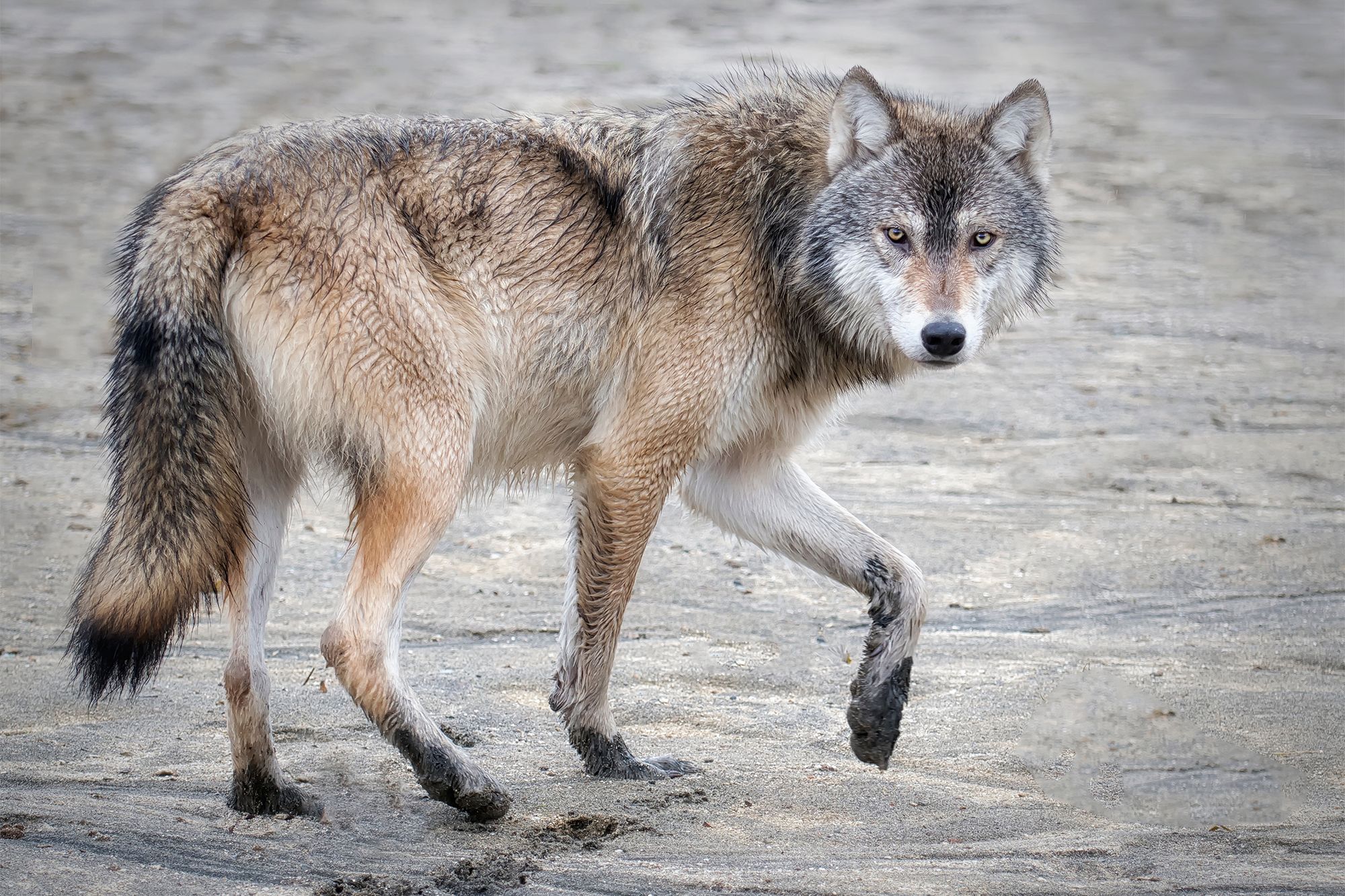
The wolves of the Great Bear Rainforest are not the same as their interior counterparts, they are something altogether different. Recognized by some researchers as a distinct ecotype, coastal wolves (Canis lupus crassodon) in this region have evolved over thousands of years in intimate relationship with the sea. Studies have shown that the majority of their diet comes not from deer or moose, but from marine sources, salmon, barnacles, clams, herring spawn, and even beached marine mammals. They swim between islands, traverse intertidal zones at low tide, and have developed behavioral adaptations uniquely suited to life on the edge of the ocean.
These wolves are physically distinct as well, often smaller and darker than their Rocky Mountain relatives, with a coat chemistry and isotopic signature that reflects a largely marine diet. They are apex predators in a landscape where the boundary between forest and ocean is not a line but a gradient, and they navigate that gradient with remarkable fluency. Watching a coastal wolf hunt along a tidal flat, disappear into the treeline, then re-emerge on a rocky point overlooking open water is one of the most visually compelling wildlife experiences in North America.
They are also elusive. These are not wolves habituated to roads or visitor infrastructure. Finding them requires knowledge of the territory, understanding of tidal cycles and pack movement, and, often, a great deal of patience. Which is exactly why this trip is different.
A Unique Conservation Partnership
Over the past year, we've been working closely with our partners at the lodge. There is a thriving wolf population in this area, and an active initiative is now underway to begin systematic monitoring, tracking pack territories, identifying den sites, and building a longitudinal dataset. Pilot trips running this summer are focused on improving wolf tracking and enhancing viewing opportunities, laying the groundwork for an exceptional experience in the seasons ahead.
By 2027 and 2028, the seasons for which we're now building our program, this initiative will be well established, with accumulated data on pack behavior, movement corridors, and denning areas that will significantly enhance our ability to position guests in the right places at the right times.
Why Early Summer?
Timing is everything with coastal wolves, and early summer is when the calculus tips most strongly in our favor. June is the denning and pup-emergence period. Packs are anchored to their den sites, which means their movement patterns become more predictable. The pups, newly emerged and still wholly dependent on the pack, create extraordinary social dynamics, adults returning with food, pups playing at the den entrance, the full behavioral vocabulary of pack life playing out in concentrated, accessible space.
Pups at this stage are vulnerable and need shelter, which means the adults are attentive, present, and often visible near the den. The pack is, in every sense, home, and that creates conditions for sustained, meaningful photographic access that simply don't exist later in the year when the pups are mobile and the pack disperses across its range.
Beyond the wolves, June offers exceptional conditions across the board. Marine wildlife is highly active, humpbacks are feeding in the channels, orcas are present, sea otters are abundant, and shorebirds are at peak numbers. The light at this latitude in June is extraordinary: long golden hours in the morning and evening, soft directional light that sculpts the landscape, and the kind of atmospheric drama, mist, fog, low cloud, that defines coastal British Columbia at its most beautiful.
How We Work
Our primary mode of exploration is by boat, which gives us the flexibility to move through the landscape quietly and efficiently, positioning for light and behavior without the constraints of fixed access points. We'll often be on the water before dawn and back at the lodge in time for a proper breakfast before heading out again, a rhythm that maximizes our time in the field while allowing genuine rest and recovery.
When we find wolves, we slow down. We let behavior unfold. We work at respectful distances that keep the animals relaxed and our images authentic. This is not a trip for those who prefer quantity over quality, it's for photographers who want to sit with a subject until the frame reveals itself.
The Full Picture
Wolves are our primary focus and the thread that runs through the week, but Pacific Predators is designed to deliver across the full breadth of what this ecosystem offers. On any given day we may photograph coastal wolves in the early morning, spend midday on the water with humpbacks or orcas, and end the afternoon watching a grizzly work the shoreline in the last golden light. The lodge is a base worthy of the surroundings: oceanfront cabins, exceptional food, and a fully all-inclusive experience that lets you focus entirely on the photography.
This is one of the most beautiful, best-preserved ecosystems on Earth. We have rare access, an extraordinary cast of wildlife, and a seasonal window that puts us exactly where we need to be. For photographers who care about wild places and want images that elevate above the rest, this is about as good as it gets.
What's Included
All listed meals and non-alcoholic beverages during the workshop
All transportation during the workshop
All lodging during the workshop
Airport transfers
All permits and park fees
Internal flights to/from Bella Bella, BC
Professional photography guiding and instruction
Gratuity for service staff
What's Not Included
Flights to/from Vancouver, BC
Meals not listed as included on the itinerary
Lodging outside workshop dates
Alcoholic beverages
Souvenirs and personal items
Gratuity for photography guide and local guides. Please refer to our FAQ section for more details about gratuities
Trip Insurance & Medical Evacuation Insurance (required) - see plans here.
Details
- Final Balance Due 150 days prior to Trip Start
- Specialized Itinerary terms & conditions apply. Please see our Cancellation / Transfer policy on our Frequently Asked Questions page.
- Trip Insurance Required


Trip Itinerary
Trip Itinerary
Most meals included – (B,L,D) denotes Breakfast, Lunch, Dinner
Day 1: Arrival in Vancouver (D)
We’ll meet in Vancouver in the evening to kick things off with a group orientation and welcome dinner. This is a great chance to get to know one another, go over the plan for the week, and prepare for the adventure ahead. We’ll discuss gear, expectations, and what it takes to photograph wildlife in one of the most remote ecosystems on the planet.
Day 2: Into the Great Bear Rainforest (B,L,D)
This morning, we’ll board a scenic flight to Bella Bella, following the rugged coastline and glaciated peaks of British Columbia. From there, we’ll transfer to the docks and begin our boat journey north toward the lodge. Keep your camera ready—this is our first opportunity to photograph marine wildlife along the way. Upon arrival, we’ll settle in, get oriented, and enjoy our first evening together overlooking the Great Bear Sea.
Days 3–7: Coastal Wolves & Wild Encounters (B,L,D)
Our days are fully dedicated to exploring the Great Bear Rainforest in search of wildlife, with a special focus on coastal wolves. Each morning, we’ll head out by boat into a constantly changing landscape of estuaries, river systems, and remote shoreline. Because wolves are elusive, we’ll embrace a patient, quiet approach—often waiting in promising locations and letting the scene unfold naturally. The reward can be extraordinary!
Beyond wolves, we’ll have excellent opportunities to photograph grizzly bears, humpback whales, and possibly orcas, along with eagles and a variety of coastal wildlife. Some days we’ll stay in one location, while others we’ll explore more broadly depending on conditions. Evenings are relaxed and rewarding, with great meals, image sharing, and opportunities to learn more about the Kitasoo Xai'xais culture through stories and presentations.
Day 8: Departure (B)
After a final breakfast, we’ll say our goodbyes and begin the journey back to Bella Bella by boat, with one last chance for wildlife sightings along the way. From there, we’ll board our return flight to Vancouver, wrapping up an unforgettable week in one of the wildest places left on earth.
Please note that the exact sequence of the itineraries on all photography trips will be based on weather and lighting conditions. The goal on these trips is to make sure we are at the right place at the right time for the perfect light on our subjects. Also, itineraries can change for a variety of other circumstances including floods, forest fires, national park closures, road closures, and more. Due to the nature of wildlife and landscape photography, we do not guarantee any specific sightings or specific compositions.
Physical Requirements
This workshop is rated as a Fitness Level 2. Most days involve minimal walking, with the majority of wildlife viewing done from boats or at short distances from drop-off points. When walking is required, distances are typically a few hundred meters (roughly 0.1–0.2 miles), though rare outings may involve walks of up to approximately 1 mile.
Terrain can vary widely and may include uneven riverbanks, muddy or cobbled surfaces, forest trails, and natural obstacles such as fallen logs. In some locations, guests may encounter short sections with steps cut into riverbanks or rope assists to help navigate steeper or slippery areas.
This trip is best suited for guests who are comfortable walking on uneven and occasionally slippery terrain at a relaxed pace. It is not recommended for guests with significant mobility limitations or those unable to safely manage variable outdoor conditions.
Why Choose Backcountry Journeys?
UNPARALELLED
PHOTOGRAPHY
TRIPS
PHOTOGRAPHY
TRIPS
arrow_drop_down_circle
Divider Text
Explore over 100 worldwide photo tours and workshops tailored to photographers of all skill levels, from iconic U.S. National Parks to Africa's untamed savannahs.
THE BEST TEAM
IN THE
BUSINESS
IN THE
BUSINESS
arrow_drop_down_circle
Divider Text
We're proud to offer unmatched photography trips led by exceptional instructors who not only excel in photography but also serve as expert guides.
WORLD-CLASS
PHOTOGRAPHY
COMMUNITY
PHOTOGRAPHY
COMMUNITY
arrow_drop_down_circle
Divider Text
Join the Backcountry Journeys Tribe, where shared adventures in breathtaking locations foster lasting connections with fellow photographers in a warm, inclusive atmosphere.


[Block//Review]
[Block//Trip Reviewer//First Name] - [Block//Date Of Review %n/j/Y%+0]
Verified Guest

Worry Free Travel Guarantee!
Worry Free Travel Guarantee!

HERE’S THE DEAL
We offer one of the most rock solid guarantees in the travel industry - our worry free travel, peace of mind guarantee to you!We’re so confident that the Photography Trips we offer will not only meet but exceed the lofty expectations set forth on our website – if your trip experience does not 100% match the promises laid forth on our website we will gladly give you a credit toward a future trip.
Natural events such as wildlife & weather are certainly out of our control but every aspect of the trip including logistics, accommodations, vehicles, itinerary & your expert trip leaders will match the lofty promises we’ve made on the site – we guarantee it!

Backcountry Journeys
Connecting Passionate People To
Exceptional Experiences.
Exceptional Experiences.
Business Hours:
Mon-Fri, 8AM-4PM MT
928-478-1521
adventure@backcountryjourneys.com
Mon-Fri, 8AM-4PM MT
928-478-1521
adventure@backcountryjourneys.com
arrow_drop_down_circle
Divider Text
All Images & Content Are Property Of Backcountry Journeys Photography Tours, Workshops & Safaris LLC - Copyright 2026


About Us
Receive a Digital Trip Catalog
Find an upcoming photography tour with our interactive catalog.