2025 Travelers' Choice

Stay Up To Date On All Things
Backcountry Journeys
Backcountry Journeys
Our Photography Community
Our Webinars
Our regularly hosted webinars provide photography instruction from our own guides on a wide range of topics.Our Education Portal
Explore our library of articles that cover everything from common questions, to in-depth guides on how to achieve that perfect shot.Community Testimonials
We're proud to foster an amazing group of photo travelers, and here you can find their stories from their past adventures.About Backcountry Journeys
Why Choose Backcountry Journeys
If you're considering a photography trip, hear why Backcountry Journeys delivers the best experience in the industry.Frequently Asked Questions
If you're new to photography trips, or new to BCJ, you can find our common travel questions here.Fitness Levels
Our trips vary on physical intensity, and by reviewing our fitness levels, you can find out which trips may be more challenging, or aligned more closely with your comfort level.Meet The Crew
We've built an amazing team of experienced guides, and dedicated office staff that elevate your travel experience. Get to know their backgrounds, and hear their stories.Loyalty Program
We reward our frequent photo adventurers with exclusive discounts on amazing photography trips.Contact Us
If you need to get in touch with our office staff, or have additional business inquiries, you can find our information here.Refer a Friend
Know someone perfect for one of our tours? Recommend them through this quick form.Resources For Photographers
About Our Company
Ring of Fire: Galápagos Wildlife & Eclipse
Ring of Fire: Galápagos Wildlife & Eclipse
Ship-Based Photo Safari
Upcoming Departures
arrow_drop_down_circle
Divider Text
[Block//Start Date %M j%+0] - [Block//End Date %M j, Y%+0]
[Block//Web Spots Left]
Trip Leader(s)
[Block//Trip Leader #1]
[Block//Trip Leader #2]
Starting From [Block//Current Price]
Single Supplement: +$2,995.00
[Block//Online Availability]
Deposit: $5,000.00
Start/End
Quito, Ecuador / Quito, Ecuador
Length
9 Days/8 Nights
Fitness Level
Level 1 - What's This?
Group Size
Up To 14 Guests
Highlights
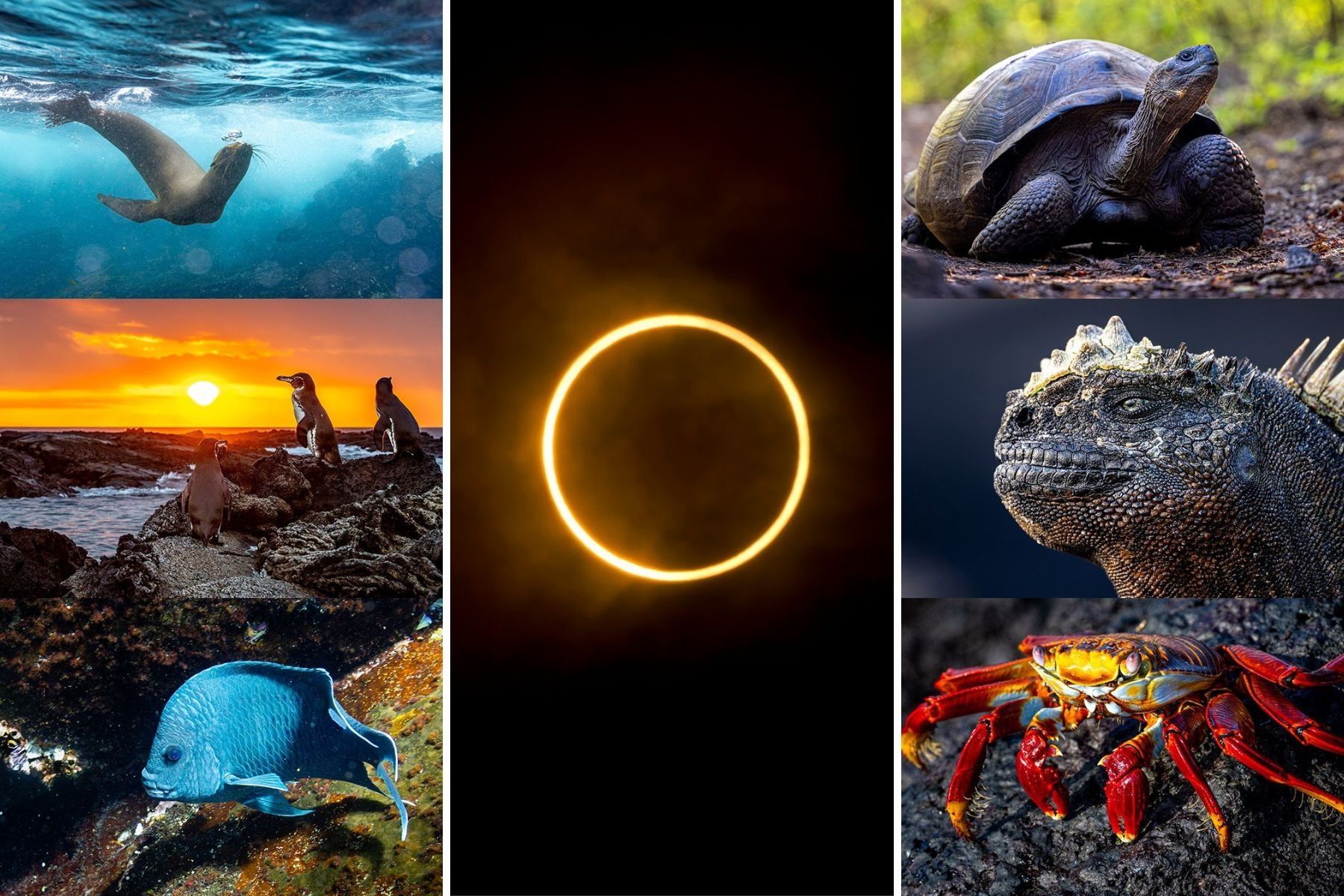
Photograph the 2028 Ring of Fire Eclipse: Capture the January 26 annular solar eclipse from the Galápagos, with our itinerary specifically arranged to position the group on land for this rare photographic event.
Iconic Galápagos Wildlife: Photograph endemic and signature species including Galápagos penguins, flightless cormorants, marine iguanas, sea lions, giant tortoises, blue-footed boobies, frigatebirds and more.
Explore the Wild Western Islands: Journey through Isabela, Fernandina, Santiago and surrounding islands, where volcanic landscapes and nutrient-rich waters create some of the archipelago’s best wildlife opportunities.
Private Yacht with Limited Single Cabins: Travel aboard a comfortable, upscale private yacht, with a limited number of single-occupancy cabins available, a rare option in the Galápagos and something not offered on our traditional Wild Galapagos departures.
Trip Description:
Ring of Fire: Galápagos Wildlife & Eclipse is a special one-off photography expedition combining one of the world’s greatest wildlife destinations with one of nature’s extraordinary celestial events. We’ll explore the western Galápagos aboard a privately chartered yacht, photographing the remarkable species and volcanic landscapes that have made this isolated archipelago a bucket-list destination for wildlife photographers, while positioning ourselves for the annular solar eclipse of January 26, 2028.
The Galápagos are unlike anywhere else on Earth. Millions of years of isolation have produced an extraordinary collection of endemic wildlife, much of it remarkably tolerant of people and approachable at close range. Our itinerary concentrates on Isabela, Fernandina, Santiago and the surrounding islands, putting us in prime habitat for Galápagos penguins, flightless cormorants, marine iguanas, Galápagos sea lions, giant tortoises, blue-footed boobies, frigatebirds and other iconic species. Late January is an especially interesting time to visit, with the islands entering the warm season, greener landscapes, active wildlife and breeding behavior among several species. Marine iguanas are also entering their breeding season, when males can display some of their most striking coloration.
At the heart of this expedition is the Ring of Fire. Unlike a total solar eclipse, an annular eclipse occurs when the Moon passes directly in front of the Sun but appears slightly too small to cover it completely, leaving a brilliant ring of sunlight surrounding the Moon. We’ve worked specifically around the eclipse to create an itinerary that allows our group to be positioned on land in the Galápagos for this rare photographic event. Rather than simply hoping to experience the eclipse while moving through a standard cruise itinerary, this departure has been built around giving photographers a dedicated opportunity to capture it.
Our private yacht, Solaris, will serve as our floating base throughout the expedition, allowing us to move between some of the archipelago’s most productive wildlife locations while returning each day to a comfortable, upscale vessel. This yacht is also one of the relatively few options in the Galápagos that can accommodate a limited number of single-occupancy cabins, something we are unable to offer on our traditional Wild Galapagos departures, which are double occupancy only.
This is not a regularly scheduled Galápagos itinerary. It is a special one-time edition, designed around the convergence of exceptional Galápagos wildlife photography and the 2028 annular eclipse, creating an opportunity that is not repeatable in the near future.
What's Included
All listed meals and non-alcoholic beverages during the workshop
All transportation during the workshop
All lodging during the workshop
Internal flights
All permits and park fees
Snorkeling gear & kayaks
Professional photography guiding and instruction
Gratuity for service staff
What's Not Included
Flights to and from Quito, Ecuador (UIO)
Meals not listed as included on the itinerary
Lodging outside workshop dates
Alcoholic beverages
Souvenirs and personal items
Gratuity for photography guide(s). Please refer to our FAQ section for more details about gratuities
Trip Insurance & Medical Evacuation Insurance (required) - see plans here.
Details
- Final Balance Due 180 days prior to Trip Start
- Standard terms & conditions apply. Please see our Cancellation / Transfer policy on our Frequently Asked Questions page.
- Trip Insurance Required


Trip Itinerary
Trip Itinerary
Most meals included – (B,L,D) denotes Breakfast, Lunch, Dinner
Day 1: Arrival in Quito (D)
Arrive in Quito, Ecuador, where your lodging for the evening is included. Guests can settle in before meeting the group at 5:00 PM for our trip orientation. We’ll review the adventure ahead, discuss photography and eclipse preparation, and make sure everyone is ready for our journey to the Galápagos the following morning.
Day 2: Fly to the Galápagos & Bachas Beach (B, L, D)
This morning we’ll fly from Quito to Baltra Island, where we’ll meet our Galápagos naturalist team and transfer to our private yacht. After boarding, settling into our cabins, and enjoying lunch, our first exploration takes us to Bachas Beach on Santa Cruz Island.
The brilliant white coral sand here provides our introduction to the remarkable wildlife of the Galápagos. Sea turtles use these beaches as nesting habitat, while a nearby brackish lagoon can attract flamingos, black-necked stilts, whimbrels, and other coastal birds.
Day 3: Ring of Fire Eclipse & Southern Isabela (B, L, D)
Today is the centerpiece of this special-edition expedition: the January 26, 2028 annular solar eclipse.
Our yacht will be anchored just offshore from Isabela Island, near Puerto Villamil, and we have received special permission to go ashore early so our group can be in position well before the eclipse begins. From a nearby beach, we’ll be able to set up our equipment on land and photograph the event from a stable vantage point.
This gives us the opportunity to photograph the entire eclipse sequence, including the dramatic annular phase when the Moon passes in front of the Sun but does not completely cover it, leaving the brilliant “Ring of Fire” visible around its edge.
After the eclipse concludes, we’ll return to the yacht and continue exploring southern Isabela, including Whitetip Reef Shark Channel, where wildlife can include Galápagos penguins, sea lions, herons, whitetip reef sharks, and large concentrations of marine iguanas. We’ll also visit Isabela’s wetlands and giant tortoise breeding center, with additional opportunities for flamingos and other birdlife.
Day 4: Moreno Point, Fernandina & Tagus Cove (B, L, D)
We continue deeper into the western Galápagos with a morning exploration of Moreno Point on Isabela. Here, young lava flows are punctuated by coastal lagoons and mangroves that attract a variety of birdlife.
Later, we enter the productive waters of the Bolívar Channel, exploring Mangle Point on Fernandina and Tagus Cove on Isabela. A zodiac excursion along the cliffs can provide opportunities to photograph Galápagos penguins, flightless cormorants, and other seabirds, while those who wish can hike above Tagus Cove for views of Darwin Lake and the surrounding volcanic landscape.
Day 5: Fernandina & Vicente Roca Point (B, L, D)
This may be one of our strongest wildlife photography days of the entire expedition.
We’ll land at Espinoza Point on Fernandina, one of the most pristine islands in the Galápagos and an exceptional location for marine iguanas. Huge numbers can gather along the shoreline and lava formations, and this is also important habitat for the endemic flightless cormorant.
In the afternoon we cross back toward Vicente Roca Point on Isabela, where dramatic cliffs, caves, and sheltered coves create another excellent wildlife setting. The surrounding waters can hold penguins, sharks, pufferfish, seahorses, and other marine life, with snorkeling opportunities depending on conditions.
Day 6: Santiago Island (B, L, D)
Today we explore Santiago Island, beginning around Espumilla Beach and Buccaneer Cove. Espumilla is an important sea turtle nesting area surrounded by mangroves and volcanic scenery.
Later, we visit Egas Port, where black volcanic coastlines, natural arches, caves, and lava formations create a beautiful backdrop for wildlife photography. Galápagos fur seals and sea lions utilize the shoreline, while brightly colored Sally Lightfoot crabs stand out dramatically against the dark basalt.
Day 7: Rábida & Chinese Hat (B, L, D)
Our morning takes us to Rábida, one of the most visually distinctive islands in the archipelago. Iron-rich volcanic material gives the beach its deep reddish color, creating a striking setting for wildlife photography. The island supports aquatic birds, songbirds, brown pelicans, and occasionally flamingos around its lagoon.
Later we explore Chinese Hat, a small volcanic islet near Santiago. Here we can encounter Galápagos sea lions, marine iguanas, and potentially Galápagos penguins among young lava formations and white coral beaches.
Day 8: Santa Cruz & Return to Quito (B, L, D)
Our final morning in the Galápagos brings us to Santa Cruz Island and the Charles Darwin Research Station, where we’ll learn more about the conservation work protecting the archipelago and have another opportunity to see Galápagos giant tortoises.
Afterward, we’ll transfer back to Baltra Airport for our flight to mainland Ecuador. Upon arrival in Quito, we’ll transfer to our included hotel for our final overnight and enjoy dinner together.
Day 9: Departure (B)
Today is primarily a travel day. After breakfast at the hotel, guests can depart for home according to their individual flight schedules.
Please note that the exact sequence of the itineraries on all photography trips will be based on weather and lighting conditions. The goal on these trips is to make sure we are at the right place at the right time for the perfect light on our subjects. Also, itineraries can change for a variety of other circumstances including floods, forest fires, national park closures, road closures, and more. Due to the nature of wildlife and landscape photography, we do not guarantee any specific sightings or specific compositions.
Physical Requirements
Most trips begin with a night in Quito (9,300 ft elevation), where some guests may feel mild altitude symptoms like headache or fatigue. Stay hydrated, rest, and speak with your doctor ahead of time if you're concerned.
This trip involves moderate physical activity, including light hiking, nature walks, kayaking, and snorkeling. While there are no strenuous hikes, expect some walks on uneven terrain, such as volcanic rock and sandy paths, with distances of up to 1-2 miles. Kayaking and snorkeling opportunities are included, but optional, and guests should feel comfortable with these activities in warm, tropical waters. High-quality snorkeling gear will be available, but you are welcome to bring your own. Getting in and out of pangas (small boats) is required, sometimes without stable footing, and balance is important. While no strenuous hiking is included, guests should be comfortable being active for several hours a day, whether in the water or on shore.
Boat rides between islands can be rough, so bringing seasickness remedies is recommended.
The trip will involve long days, with early mornings and late evenings for wildlife photography, so stamina is important. Comfortable, supportive footwear is recommended for walking and boat rides, and guests should also be prepared for the tropical climate.
Why Choose Backcountry Journeys?
UNPARALELLED
PHOTOGRAPHY
TRIPS
PHOTOGRAPHY
TRIPS
arrow_drop_down_circle
Divider Text
Explore over 100 worldwide photo tours and workshops tailored to photographers of all skill levels, from iconic U.S. National Parks to Africa's untamed savannahs.
THE BEST TEAM
IN THE
BUSINESS
IN THE
BUSINESS
arrow_drop_down_circle
Divider Text
We're proud to offer unmatched photography trips led by exceptional instructors who not only excel in photography but also serve as expert guides.
WORLD-CLASS
PHOTOGRAPHY
COMMUNITY
PHOTOGRAPHY
COMMUNITY
arrow_drop_down_circle
Divider Text
Join the Backcountry Journeys Tribe, where shared adventures in breathtaking locations foster lasting connections with fellow photographers in a warm, inclusive atmosphere.


[Block//Review]
[Block//Trip Reviewer//First Name] - [Block//Date Of Review %n/j/Y%+0]
Verified Guest

Worry Free Travel Guarantee!
Worry Free Travel Guarantee!

HERE’S THE DEAL
We offer one of the most rock solid guarantees in the travel industry - our worry free travel, peace of mind guarantee to you!We’re so confident that the Photography Trips we offer will not only meet but exceed the lofty expectations set forth on our website – if your trip experience does not 100% match the promises laid forth on our website we will gladly give you a credit toward a future trip.
Natural events such as wildlife & weather are certainly out of our control but every aspect of the trip including logistics, accommodations, vehicles, itinerary & your expert trip leaders will match the lofty promises we’ve made on the site – we guarantee it!

Backcountry Journeys
Connecting Passionate People To
Exceptional Experiences.
Exceptional Experiences.
Business Hours:
Mon-Fri, 8AM-4PM MT
928-478-1521
adventure@backcountryjourneys.com
Mon-Fri, 8AM-4PM MT
928-478-1521
adventure@backcountryjourneys.com
arrow_drop_down_circle
Divider Text
All Images & Content Are Property Of Backcountry Journeys Photography Tours, Workshops & Safaris LLC - Copyright 2026


About Us
Receive a Digital Trip Catalog
Find an upcoming photography tour with our interactive catalog.