2025 Travelers' Choice

About Backcountry Journeys
Why Choose Backcountry Journeys
If you're considering a photography trip, hear why Backcountry Journeys delivers the best experience in the industry.Frequently Asked Questions
If you're new to photography trips, or new to BCJ, you can find our common travel questions here.Fitness Levels
Our trips vary on physical intensity, and by reviewing our fitness levels, you can find out which trips may be more challenging, or aligned more closely with your comfort level.Meet The Crew
We've built an amazing team of experienced guides, and dedicated office staff that elevate your travel experience. Get to know their backgrounds, and hear their stories.Loyalty Program
We reward our frequent photo adventurers with exclusive discounts on amazing photography trips.Contact Us
If you need to get in touch with our office staff, or have additional business inquiries, you can find our information here.Refer a Friend
Know someone perfect for one of our tours? Recommend them through this quick form.Stay Up To Date On All Things
Backcountry Journeys
Backcountry Journeys
Our Photography Community
Our Webinars
Our regularly hosted webinars provide photography instruction from our own guides on a wide range of topics.Our Education Portal
Explore our library of articles that cover everything from common questions, to in-depth guides on how to achieve that perfect shot.Community Testimonials
We're proud to foster an amazing group of photo travelers, and here you can find their stories from their past adventures.Resources For Photographers
About Our Company
Resources For Photographers
About Our Company
Trip Report: Death Valley and Alabama Hills - February 2026
Published August 11, 2026
Heat, Stone & Light
There are landscapes that ask something of you before they give anything back. Death Valley is one of them. It is the largest national park in the contiguous United States, a place of such extremes — the lowest point in North America, some of the most violent color geology on the continent, skies so clear and dark they feel pressurized — that first-time visitors often describe a kind of sensory recalibration. The scale is wrong in the best possible way. The light is wrong in the best possible way. Everything you thought you understood about how a desert looks turns out to be based on somewhere smaller and less severe.
Combined with the Alabama Hills — that otherworldly scatter of ancient granite boulders tumbled at the feet of the Eastern Sierra, just over the mountains to the west — the two locations form one of the great landscape photography circuits in North America. The contrast alone is worth making the journey: the eroded, mineral-stained badlands of Death Valley against the massive, snow-dusted granite walls of the Sierra Nevada, with the broken boulders of the Alabama Hills sitting at the seam between them. February is when both places are at their finest — cool enough to work long sessions, clear enough for the kind of light that makes these photographs.
Death Valley: Reading the Land
Death Valley rewards photographers who are willing to study it before they photograph it. The park is enormous — nearly 5,000 square miles — and its locations are spread across a landscape that changes character every few miles. Understanding which formations face which direction, how the basin fills with shadow in the late afternoon while the surrounding ranges stay lit, and where the last light lands on the high ridgelines before it disappears entirely: this knowledge is what separates a productive day in the field from a day spent driving between pullouts.
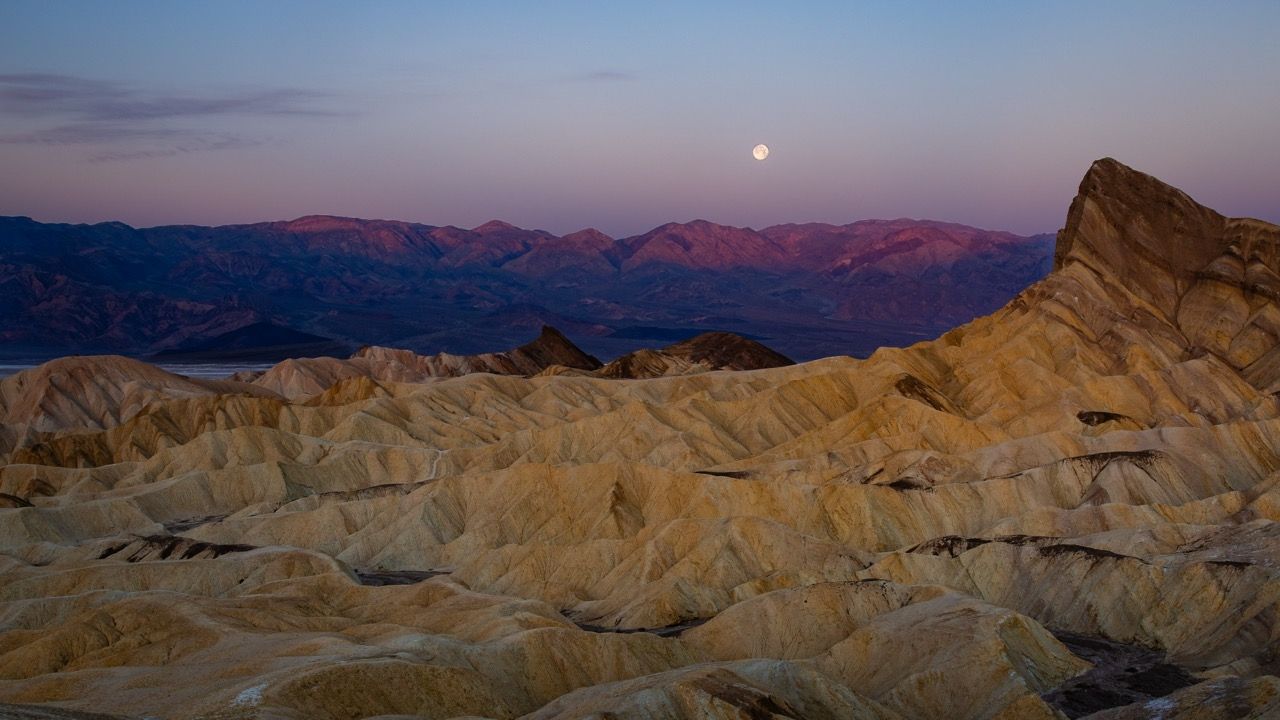
Zabriskie Point is the location most visitors know, and for good reason — the eroded badlands spreading out below the viewpoint, with the Panamint Range rising behind them, offer one of the most compositionally generous views in the American West. But Zabriskie is a location that reveals its depth over multiple visits at different times of day, and in different phases of the moon. At dusk, as last light leaves the high ranges and the moon climbs into a sky still holding color from sunset, the badlands take on a warmth and dimensionality that the midday version of this view never approaches.
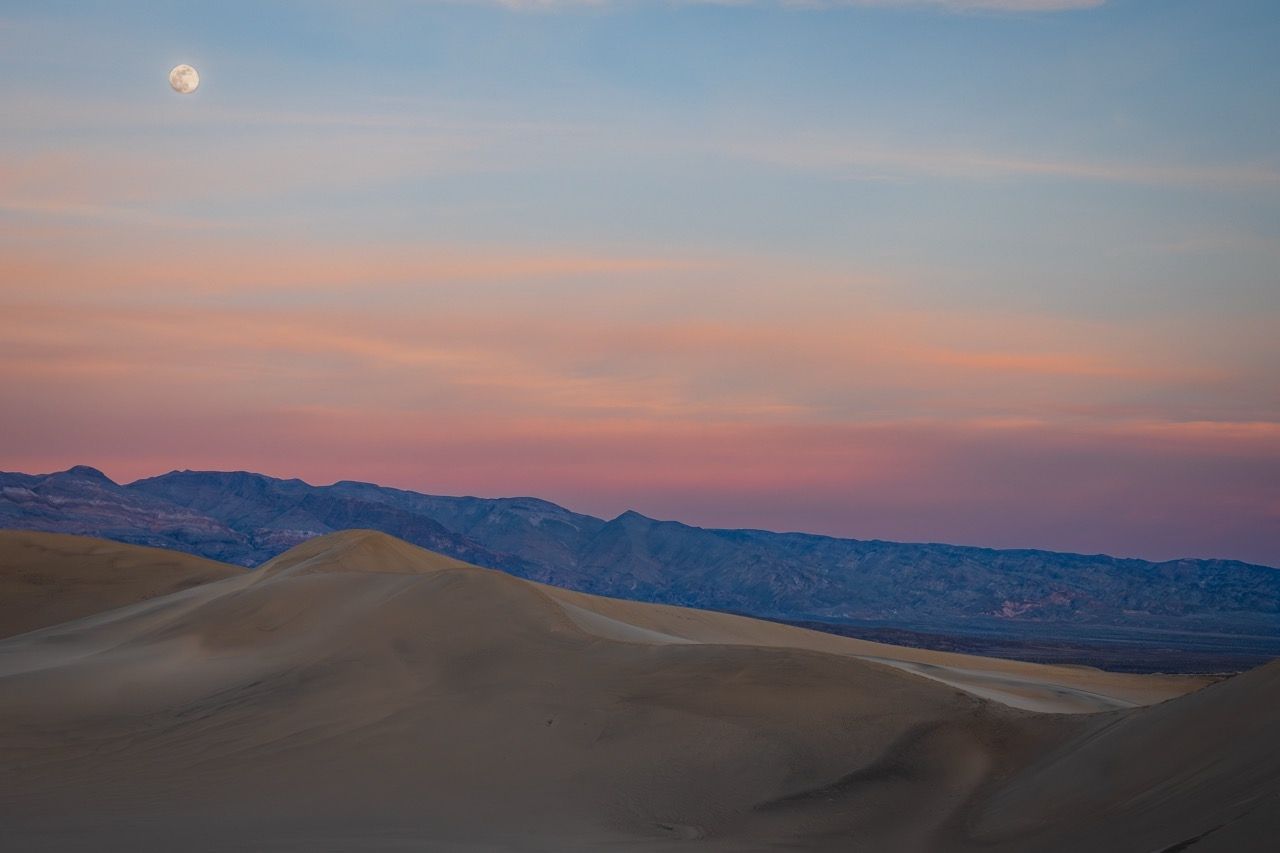
The Mesquite Flat Sand Dunes, in the northern part of the valley, offer a completely different kind of challenge. Sand dunes are deceptively simple subjects — smooth, curved, and apparently easy to compose — until you start working them and realize how much depends on the angle of light and the sharpness of the ridgelines. Wind erases footprints and restores the dune crests overnight, so early morning and dusk sessions deliver a clean, untracked surface that catches raking light with extraordinary precision. The dunes also provide one of the rare spots in Death Valley where the sky plays an active role in the composition, with the Cottonwood Mountains serving as a backdrop and the open horizon above giving weather and moonrise room to perform.
"Death Valley is a place of such extremes that first-time visitors often describe a kind of sensory recalibration."
The Geology of Color
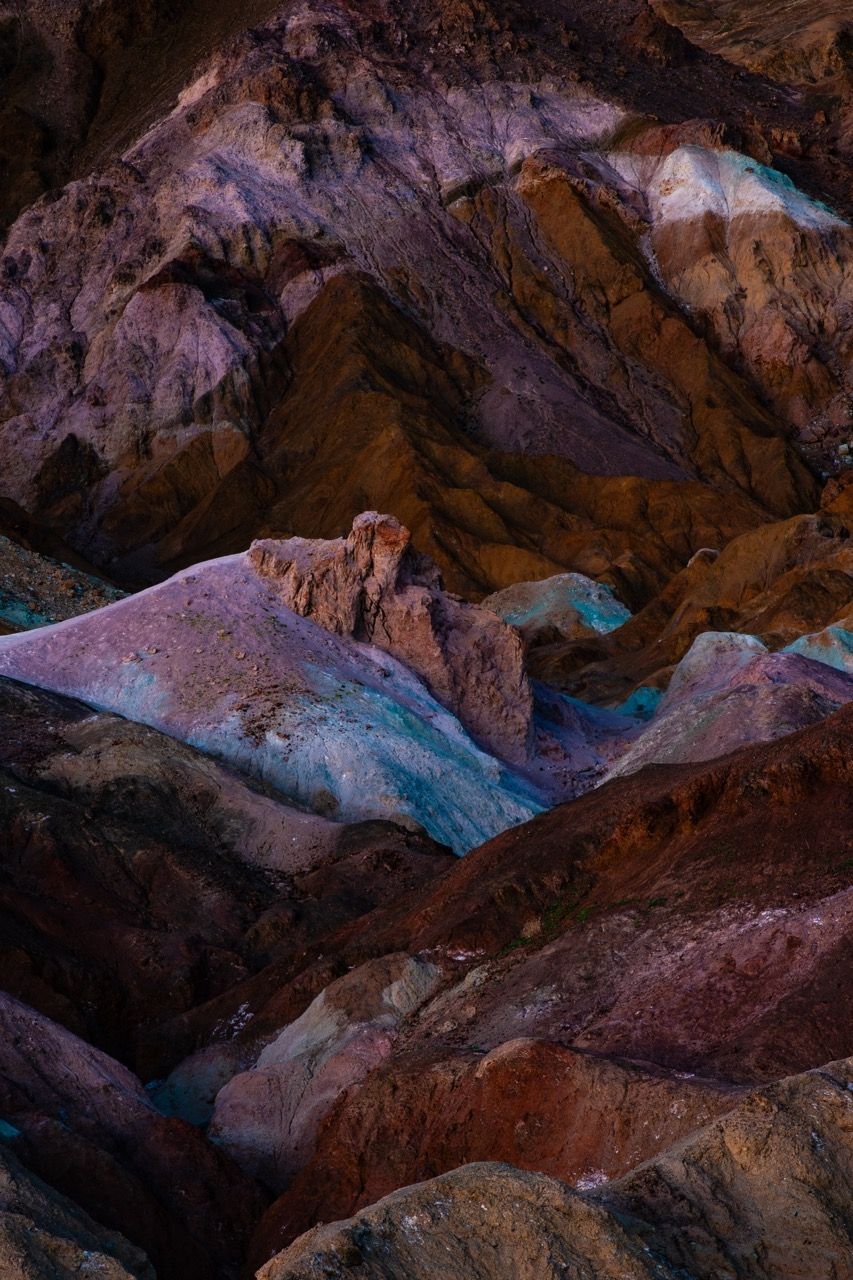
No location in Death Valley demonstrates the park's geological extravagance more directly than Artist's Palette — a section of the Black Mountains where volcanic deposits have oxidized into a palette that seems physically impossible for rock: deep purples, rust reds, pale greens, teal blues, and warm ochres, all layered and folded together in formations that change hue as the light angle shifts through the afternoon. The scientific explanation involves iron compounds and manganese oxide, but standing in front of it, the experience is less geological than painterly. It looks like someone made it up.
The light in late afternoon catches the mineral faces of Artist's Palette at an angle that deepens every color and separates the layers visually in a way that flatter midday light completely flattens. The key is being in position as the sun drops toward the Panamint crest — the window when the formation is fully lit from the side is brief, and the images made in that window are a fundamentally different photograph from anything made an hour earlier.
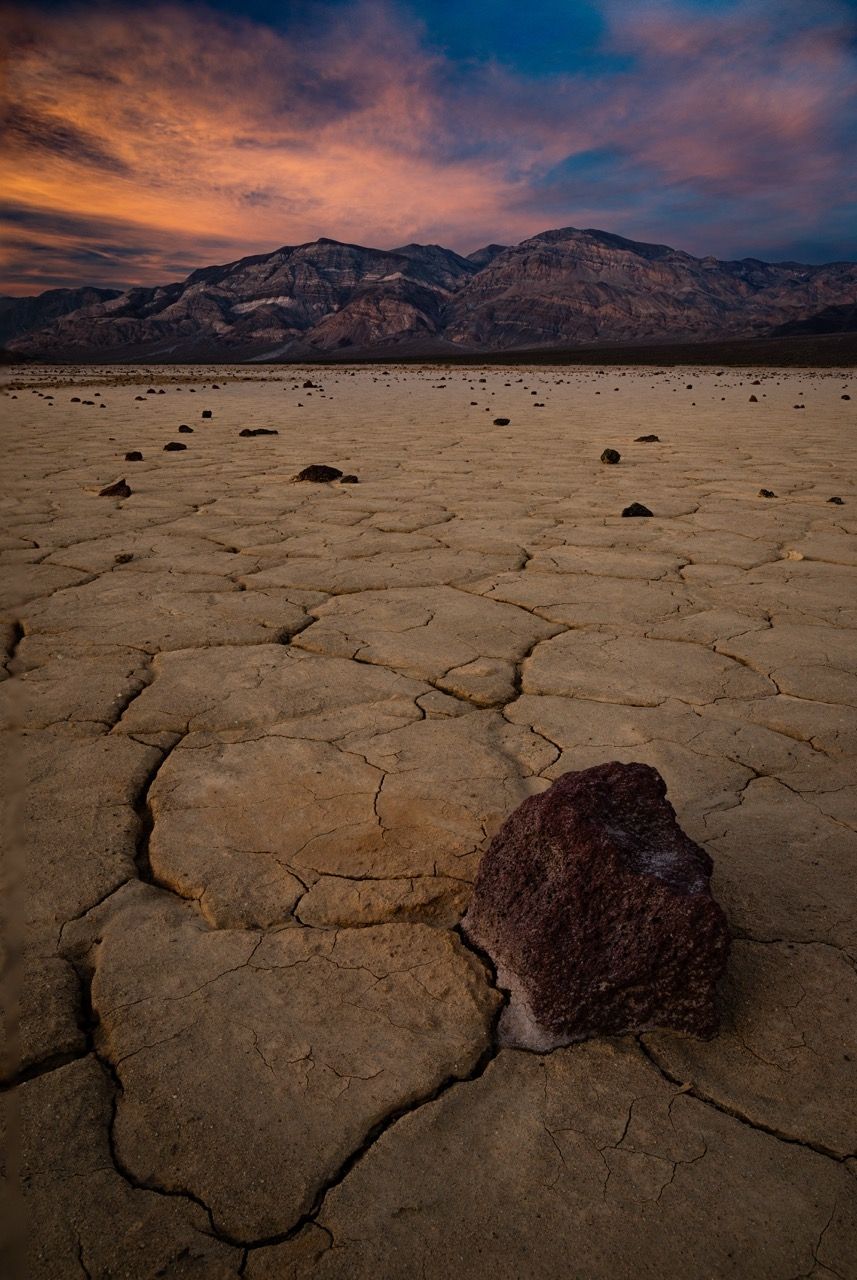
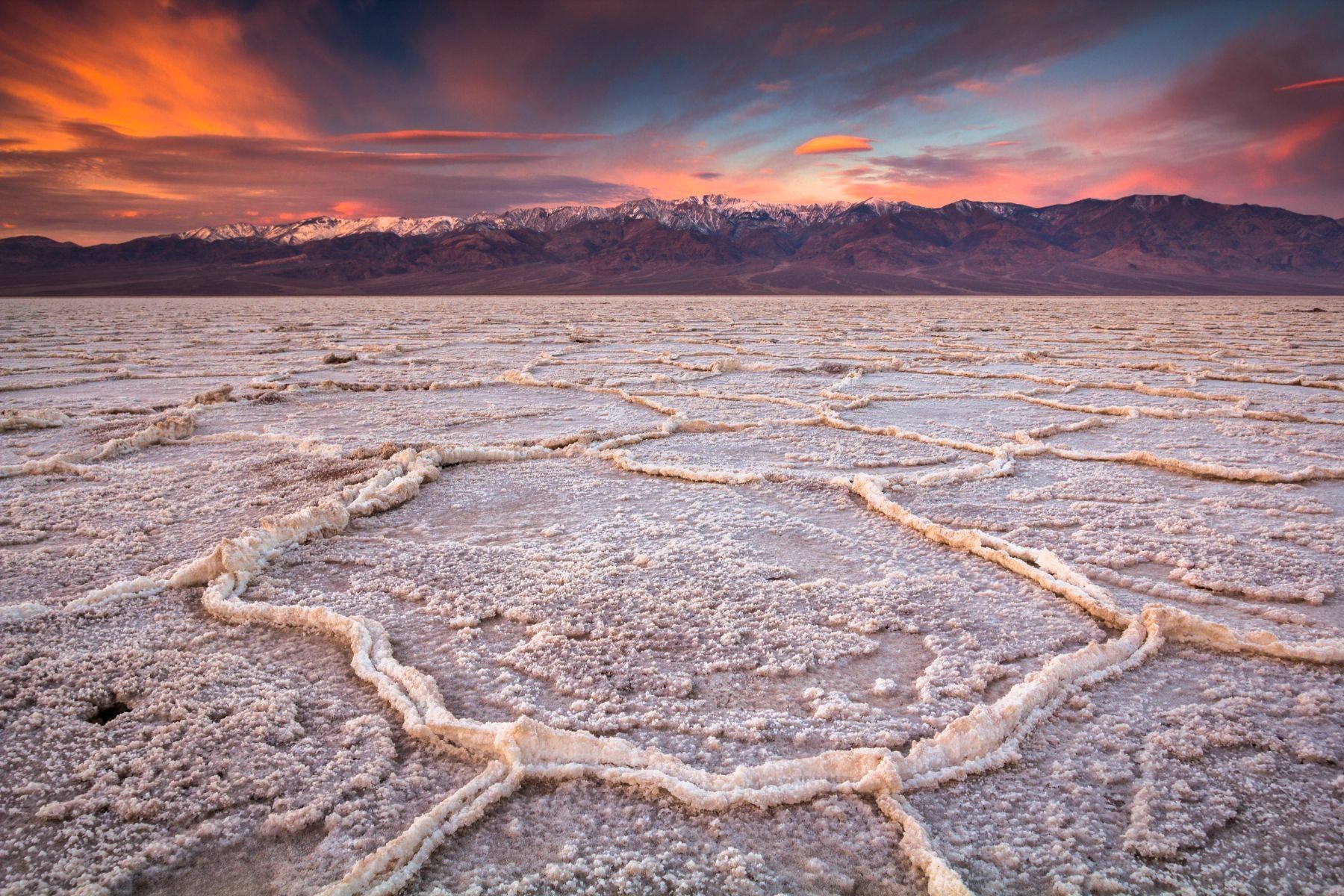
The valley floor itself — vast, flat, and in places still bearing the cracked geometry of ancient lake beds — provides foreground opportunities that are easy to overlook in favor of the more dramatic elevated formations. The playa surfaces, particularly in the southern reaches of the park near the Devil's Golf Course and the Racetrack, carry a visual logic of their own: the hexagonal cracks of dried mud, the scattered dark boulders that appear to have simply arrived from somewhere else, the way a wide-angle lens pressed close to the cracked earth creates a sense of infinite extension toward the mountains on the horizon. These are intimate, ground-level images that anchor a portfolio of grand vistas in something concrete and textural.
The Alabama Hills: Where Desert Meets Sierra
The drive from Death Valley over Townes Pass and down into the Owens Valley is a transition that arrives like a scene change in a film. The mineral strangeness of the valley gives way, gradually, to sagebrush flats and then to the sight that stops people mid-sentence: the Eastern Sierra, rising abruptly and massively from the valley floor, snow-covered well into spring, with the Alabama Hills tumbling across the flats in front of them like the ruins of something enormous. The juxtaposition — warm orange granite in the foreground, cold white peaks behind — is one of the iconic compositions of American landscape photography, and it earns that status.
The Alabama Hills are a geological anomaly: ancient granite that predates the Sierra Nevada by hundreds of millions of years, rounded and sculpted by weather into forms that range from cathedral spires to smooth, body-sized boulders to natural arches threading through the rock. The landscape has served as a film location for more than a century — the broken terrain and dramatic Sierra backdrop made it a natural stand-in for the American West in countless westerns — and walking through it today, that cinematic quality is still immediately apparent. Every turn reveals a new frame.
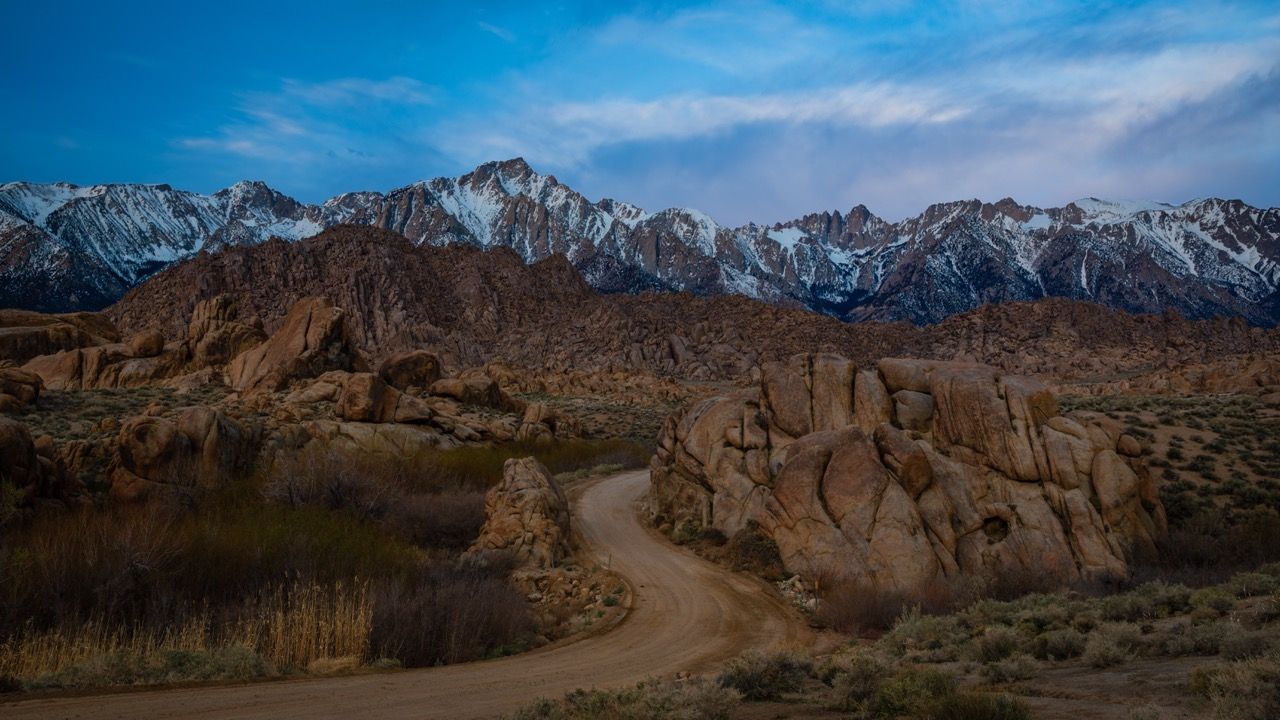
The rock formations themselves are the primary subject during midday and overcast light, when the Sierra behind them falls into a cool blue shadow that makes the warm orange granite pop with unusual intensity. At sunrise and sunset, the dynamic reverses: the high peaks catch alpenglow in shades of pink and coral while the valley floor is still in shade, and the Alabama Hills formations become dark silhouettes against the illuminated mountain wall. Both moods are worth shooting, and understanding the difference — when to expose for the foreground, when to expose for the sky — is one of the recurring technical conversations of this location.
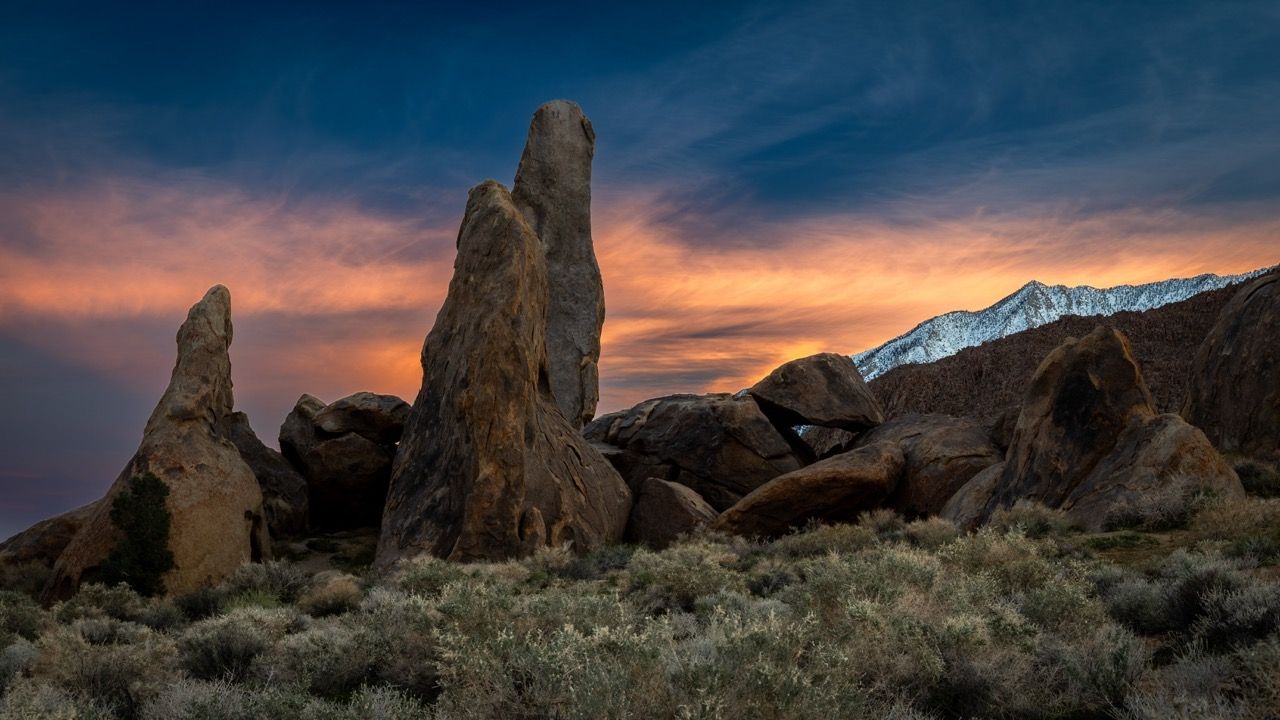
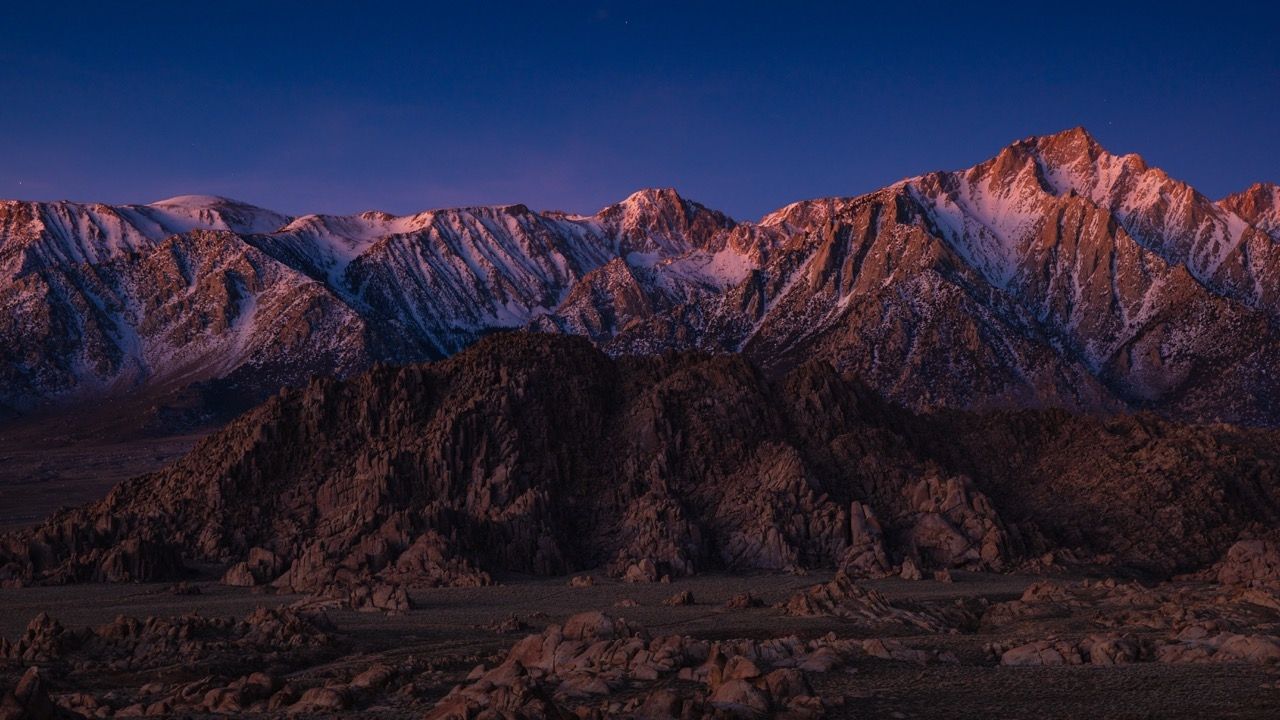
"The Alabama Hills earn their reputation — every turn reveals a new frame, a new relationship between warm granite and cold Sierra sky."
The Eastern Sierra: Long Light, Long Exposures
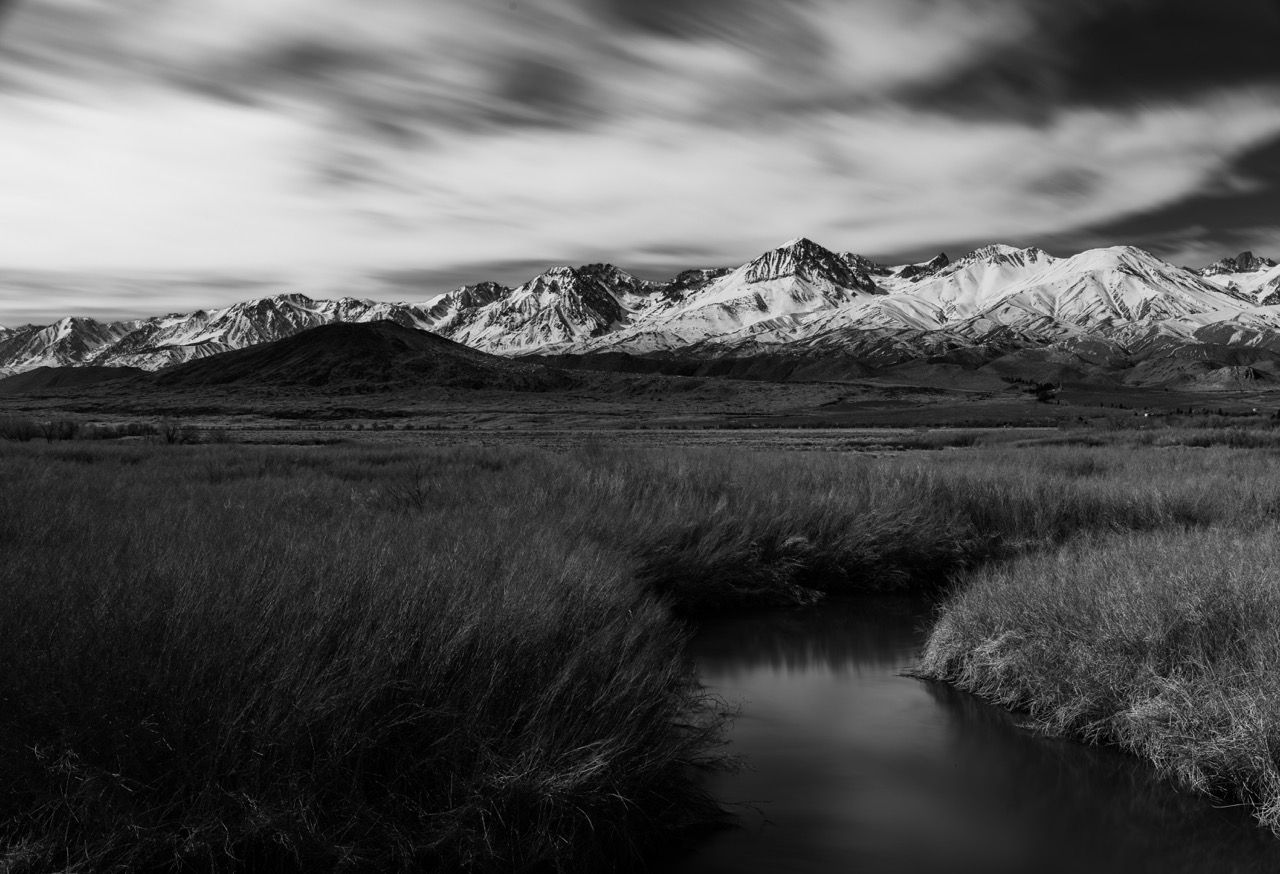
The Owens Valley, running north from the Alabama Hills along the base of the Sierra Nevada, is one of the most photogenic stretches of highway in California — a corridor of sagebrush flats, wetland channels, volcanic formations, and relentless mountain backdrop that rewards slow driving and frequent stops. In February, with snow on the peaks and the high country inaccessible, the valley floor takes on a wintry stillness that suits long-exposure work particularly well.
The wetlands and stream channels scattered through the valley carry reflections of the Sierra that a clear-sky day in summer never produces. With moving cloud overhead and a long shutter speed, the water surface becomes a mirror of sweeping motion — the peaks locked and sharp in reflection while the sky above them blurs into long pale streaks. Black-and-white rendering strips the scene to its essential geometry: the horizontal band of water and grass, the dark foreground hills, the brilliant Sierra crest, and the sky in motion above it all. It is a different register than the saturated color of Death Valley, but no less powerful.
Two Landscapes, One Workshop
The Death Valley and Alabama Hills workshop works because the two locations are genuinely complementary — not just geographically close, but photographically opposite in ways that make each one teach something the other cannot. Death Valley is a place of abstraction and color and geological time, where the scale of the landscape dwarfs the human frame and the challenge is finding intimacy within it. The Alabama Hills are a place of tangible structure, of rocks you can touch and formations you can walk through, where the drama comes from the relationship between the near and the far, the old granite and the young Sierra snow.
Moving between them over the course of a week gives participants a range of compositional problems to solve and a range of light conditions to work with — from the extreme contrast of Death Valley midday to the soft, directional alpenglow of the Eastern Sierra at dawn. The editing sessions each evening become a conversation about how different places demand different approaches: when to use a wide angle and press close to the earth, when to pull back and let the landscape organize itself, when to convert to black and white and when the color is too essential to abandon.
What both places share is a quality of light that is unlike anywhere else in North America. The desert air is dry and clean in a way that amplifies color saturation and edge sharpness in ways that coastal or forested environments simply cannot match. The mountains are high and close and luminous. And the sky, particularly in February when weather systems are still moving through, has a drama and range that makes every session in the field feel genuinely unpredictable — which is another way of saying genuinely alive.
 Death Valley & Alabama Hills
 Lodge-Based Photo Workshop
From $5,995.00
Up To 7 Guests
Fitness Level 2 - What's This?
Wanna Get Away?
Starts
Current Price:$0.00
Start: Las Vegas, NV
Led By
Start: Las Vegas, NV
Led By

Backcountry Journeys
Connecting Passionate People To
Exceptional Experiences.
Exceptional Experiences.
Business Hours:
Mon-Fri, 8AM-4PM MT
928-478-1521
adventure@backcountryjourneys.com
Mon-Fri, 8AM-4PM MT
928-478-1521
adventure@backcountryjourneys.com
arrow_drop_down_circle
Divider Text
All Images & Content Are Property Of Backcountry Journeys Photography Tours, Workshops & Safaris LLC - Copyright 2026


About Us
Receive a Digital Trip Catalog
Find an upcoming photography tour with our interactive catalog.